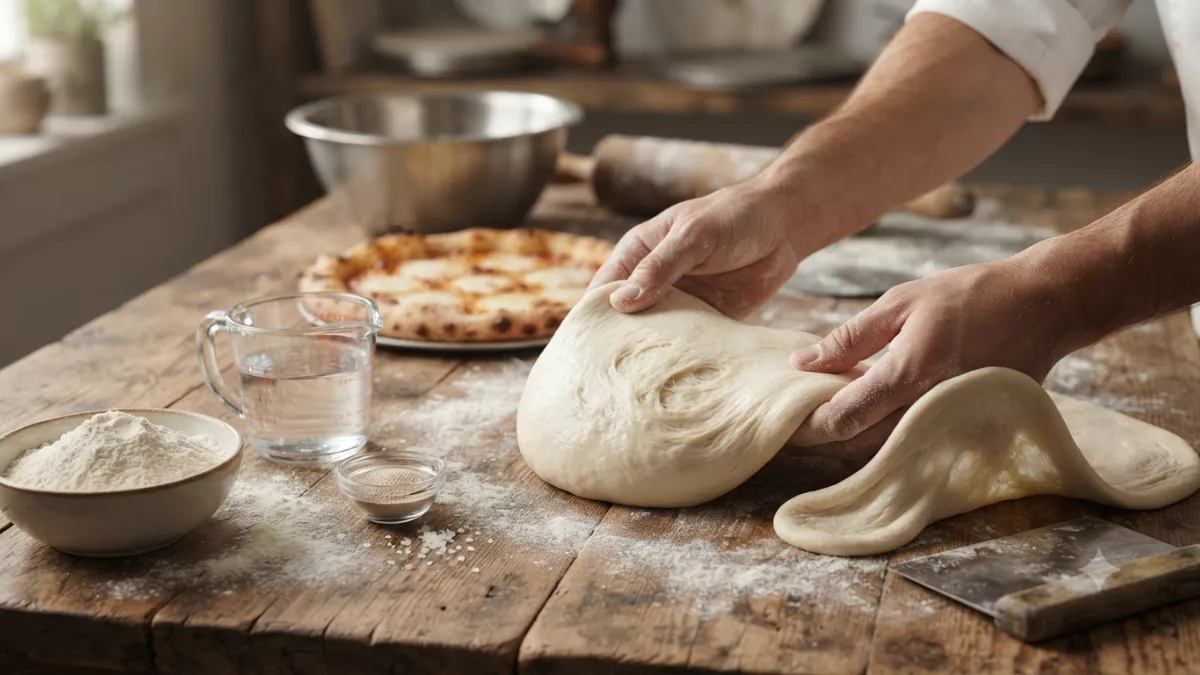
A good pizza crust should have character. Depending on the style, it might be crisp around the edges, soft in the center, airy, tender, or pleasantly chewy. But there is an important difference between a crust with a satisfying chew and dough that becomes excessively tough or rubbery.
If your homemade pizza dough consistently turns out too chewy, the problem may not be your toppings or oven. The answer often starts with the dough itself.
Flour, water, gluten development, kneading, fermentation, hydration, and baking temperature all influence the final texture of pizza dough. Even small changes in these factors can produce a noticeably different crust.
Understanding why pizza dough becomes chewy makes it much easier to control the result.
In this guide, we will explain the role of flour, water, and kneading, along with fermentation, hydration, temperature, shaping, and baking. Whether you prefer a thin New York-style crust or a thicker, softer pizza, these principles can help you create the texture you want.
What Makes Pizza Dough Chewy?
The chewiness of pizza dough primarily comes from gluten.
Gluten develops when proteins found in wheat flour interact with water and are worked through mixing, kneading, folding, and fermentation.
When flour and water are combined, two important wheat proteins—gliadin and glutenin—begin forming a network.
This gluten network gives pizza dough strength and elasticity.
It allows the dough to stretch without immediately tearing and helps it hold the gases produced during fermentation.
A moderate amount of gluten development is essential for most pizza styles.
However, excessive gluten development combined with certain flour choices, low hydration, insufficient fermentation, or overbaking can produce a crust that feels unusually tough or chewy.
The goal is not to eliminate chewiness.
The goal is to create the right type of chew.
The Role of Flour in Pizza Dough
Flour is arguably the most important ingredient in pizza dough because it determines much of the dough’s structure.
Different flours contain different amounts and types of proteins, and their milling characteristics can vary.
High-Protein Flour
High-protein flour generally has greater potential for gluten development.
Bread flour is a common choice for pizza dough because its protein content can help produce a strong, elastic structure.
This can be useful for pizzas that need a crust capable of supporting sauce, cheese, and toppings.
However, stronger flour does not automatically mean better pizza.
If your dough formula, hydration, fermentation, and baking process are not balanced, high-protein flour can contribute to a noticeably chewy result.
All-Purpose Flour
All-purpose flour generally contains less protein than many bread flours.
It can still produce excellent pizza, particularly for home cooks.
Depending on the brand and formulation, it may create a slightly more tender crust.
For many home recipes, all-purpose flour offers a practical balance between strength and ease of handling.
Tipo 00 Flour
Tipo 00 flour is finely milled and commonly associated with Italian pizza traditions.
The “00” designation primarily refers to the fineness of milling and ash classification rather than automatically indicating a specific protein level or guaranteeing a particular texture.
Some 00 flours are designed for high-temperature pizza baking, while others have different characteristics.
Choosing flour based only on the label can therefore be misleading.
The important question is whether the flour suits your recipe, fermentation schedule, and oven.
How Water Affects Chewiness
Water has a major influence on dough texture.
The percentage of water relative to flour is known as hydration.
For example, a dough containing 650 grams of water for every 1,000 grams of flour has a hydration of 65%.
Hydration affects everything from dough handling to crust texture.
Lower-Hydration Dough
Lower-hydration doughs contain less water relative to flour.
They are often easier to handle and may produce a firmer, denser crust.
If the dough is also heavily kneaded and baked for a long time, it can become quite chewy.
Higher-Hydration Dough
Higher-hydration dough contains more water.
These doughs can be sticky and more challenging to shape, but they can also produce lighter, more open textures when handled and baked correctly.
More water does not automatically eliminate chewiness.
The final texture still depends on gluten development, fermentation, flour strength, shaping, and baking.
What Is Gluten?
Gluten is the protein network that provides structure to wheat-based dough.
Think of it as an elastic framework.
When the dough ferments, yeast produces carbon dioxide. The gluten network helps trap that gas, allowing the dough to expand.
During baking, the structure sets and becomes the framework of the crust.
A strong gluten network can produce a crust with significant chew.
A weaker or less-developed network can create a more tender and crumbly texture.
The challenge is finding the right balance for your preferred pizza style.
How Kneading Changes Pizza Dough
Kneading is one of the main ways gluten develops.
When you knead dough, you encourage the gluten-forming proteins to organize into a stronger network.
This gives the dough elasticity and strength.
But kneading is not simply a case of “more is better.”
Overworking dough can make it excessively elastic and difficult to stretch.
It may repeatedly snap back toward its original shape.
Signs Your Dough Needs More Development
Dough that needs additional development may:
- Tear easily when stretched
- Feel weak
- Fail to hold its shape
- Have a rough, poorly developed structure
- Spread excessively
Signs Your Dough May Be Too Tight
Dough that feels overly tight may:
- Snap back when stretched
- Resist shaping
- Feel unusually elastic
- Require excessive force to flatten
If this happens, the solution is not necessarily more kneading.
Often, the dough simply needs time to relax.
Resting Helps Relax Gluten
One of the most important lessons for pizza makers is that gluten needs time.
After kneading, dough can be tight and elastic.
Resting allows the gluten network to relax.
This is why pizza dough often becomes much easier to stretch after a period of rest.
If you shape dough immediately after intense mixing or kneading, it may fight back.
Letting it rest can make a dramatic difference.
This is particularly important when preparing multiple pizzas.
Fermentation Changes Texture
Fermentation is another major factor in the texture of pizza dough.
Yeast consumes available sugars and produces carbon dioxide and other compounds.
This process causes the dough to rise and contributes to flavor.
Longer fermentation can also change the structure and handling characteristics of the dough.
A well-fermented dough can become more extensible and flavorful.
An under-fermented dough may feel dense, tight, and resistant.
Same-Day Fermentation
Same-day dough can work very well when you need pizza quickly.
However, it generally requires careful control of yeast, temperature, and timing.
Cold Fermentation
Refrigerating pizza dough slows fermentation.
A cold fermentation lasting approximately 12 to 72 hours can allow flavor and texture to develop gradually, depending on the formula.
Long fermentation does not automatically guarantee better pizza, but it can provide more control and complexity when properly managed.
Why Under-Fermented Dough Can Feel Chewy
Under-fermented dough has not had enough time to develop its desired structure and flavor.
It may feel tight and resistant.
The resulting crust can be dense rather than light and airy.
If your pizza dough seems unusually chewy despite using an appropriate flour, examine your fermentation schedule.
The dough may simply need more time.
Can Over-Fermentation Cause Chewy Pizza?
Over-fermentation can create a different set of problems.
The dough may become weak, sticky, overly gassy, or difficult to shape.
Instead of producing a strong, pleasant structure, the dough may lose some of its ability to hold its shape.
The final crust may become thin, flat, fragile, or otherwise inconsistent.
Good pizza dough is about balance.
More fermentation is not always better.
Salt and Gluten Development
Salt plays several important roles in pizza dough.
It contributes flavor and influences yeast activity and gluten behavior.
Salt can strengthen the dough structure and help control fermentation.
A dough with insufficient salt may taste flat and ferment differently.
However, salt levels should be based on a tested recipe rather than adjusted randomly.
Does Oil Make Pizza Dough Less Chewy?
Oil can influence the texture of pizza dough.
Fat can coat some of the flour proteins and create a more tender mouthfeel.
That is one reason certain pizza styles and enriched doughs use olive oil.
However, oil is not a simple solution for overly chewy dough.
If your dough is tough because it is under-fermented or overworked, adding more oil may not solve the underlying issue.
The dough formula should be designed around the style of pizza you want to make.
How Baking Temperature Affects Chewiness
The oven is where the dough’s structure transforms into a finished crust.
High-temperature baking can rapidly expand the dough and set the crust.
A very hot oven can create strong browning on the outside while preserving moisture inside.
This can produce a crust that is crisp on the surface and chewy inside.
That combination is desirable for many pizza styles.
Why Low Oven Heat Can Be a Problem
If your oven is not hot enough, the pizza may need to bake for a longer period.
Longer baking can drive more moisture out of the dough.
Depending on the recipe, this can produce a crust that is dry, firm, or excessively chewy.
This is one reason properly preheating your oven is so important.
Overbaking Can Make Pizza Tough
Even a well-formulated dough can become tough if it is baked too long.
The longer pizza stays in the oven, the more moisture is lost.
A crust that begins soft and flexible can gradually become dry and hard.
Watch the pizza rather than relying only on a timer.
Look for the level of browning and texture you want.
The Difference Between Chewy and Tough
This distinction is important.
Pleasantly Chewy
A good chewy crust:
- Has resistance when you bite it
- Feels elastic but tender
- Has a flavorful interior
- May have an airy structure
- Works well with crisp exterior textures
Excessively Tough
A tough crust:
- Requires excessive chewing
- Feels dry or rubbery
- Resists biting
- May become difficult to tear
- Often lacks tenderness
A pizza can absolutely be chewy without being tough.
The objective is controlled chewiness.
Why New York-Style Pizza Is Chewy
New York-style pizza is a useful example.
A traditional New York-style slice typically has a thin crust that combines flexibility, chew, and some crispness.
Its characteristic texture comes from a combination of flour strength, dough formulation, fermentation, shaping, oven temperature, and baking time.
The crust needs enough structure to support toppings but enough flexibility to fold.
This balance is part of what makes the New York slice distinctive.
Why Thick Pizza Can Also Be Chewy
Thick pizza styles can have chewiness as well.
A thicker crust may contain a substantial gluten structure that creates a satisfying bite.
However, thicker dough needs enough time and heat to cook through.
If it is underbaked, the interior can feel gummy.
If it is overbaked, the exterior can become excessively firm.
The right balance depends on the style.
How Hydration Changes Pizza Texture
Hydration is one of the most useful variables for pizza makers.
A moderate hydration level can produce dough that is relatively easy to handle and still develops good chew and structure.
Higher hydration can produce more open and airy crusts.
Lower hydration can produce firmer dough and denser textures.
But hydration cannot be evaluated by itself.
A 65% hydration dough made with one flour can behave very differently from a 65% hydration dough made with another.
Flour absorption, fermentation, kneading, and temperature all matter.
Why Dough Temperature Matters
Temperature affects fermentation speed and dough behavior.
Warm dough generally ferments faster.
Cold dough ferments more slowly.
If your kitchen is hot, the dough may become ready sooner than expected.
If the environment is cold, fermentation may take considerably longer.
This is why experienced pizza makers often pay attention to dough temperature rather than relying entirely on a fixed clock schedule.
How to Make Pizza Dough Less Chewy
If your homemade pizza is consistently too chewy, try adjusting one variable at a time.
Give the Dough More Time
If the dough is under-fermented, extending fermentation may improve its texture.
Reduce Excessive Kneading
If the dough is extremely elastic and difficult to stretch, avoid automatically kneading it longer.
Review Your Flour
Try a flour with a different protein level or formulation.
Adjust Hydration
A modest increase in hydration may produce a softer, more open crust if your flour and baking method can handle it.
Avoid Overbaking
Remove the pizza once the crust reaches the desired level of doneness.
Improve Oven Heat
A properly preheated oven can reduce the time needed to bake the pizza and improve crust development.
A Simple Pizza Dough Process
For a reliable homemade dough, consider this general process:
Step 1: Measure Ingredients
Use a kitchen scale whenever possible.
Accurate measurements make dough behavior more predictable.
Step 2: Mix
Combine flour, water, yeast, and salt according to your recipe.
Step 3: Develop the Dough
Knead or fold until the dough develops the desired strength.
Step 4: Ferment
Allow the dough to ferment according to your schedule.
Step 5: Divide
Create individual dough portions.
Step 6: Ball
Shape each portion into a smooth dough ball.
Step 7: Rest
Allow the dough balls to relax before shaping.
Step 8: Shape
Stretch the dough gently without aggressively flattening the entire structure.
Step 9: Top
Add a balanced amount of sauce, cheese, and toppings.
Step 10: Bake
Use a thoroughly preheated oven and suitable baking surface.
This process provides a foundation for controlling texture.
How to Test Dough Development
Pizza makers can use several methods to judge dough development.
The windowpane test is one option.
Take a small piece of dough and gently stretch it.
If it can stretch into a thin membrane without immediately tearing, the gluten network has developed significantly.
However, the windowpane test is not a universal requirement for every pizza style.
Some doughs are intentionally mixed less aggressively and rely more heavily on time and fermentation for development.
Why Hand Stretching Matters
How you shape the dough can affect its final texture.
Gentle hand stretching preserves some of the gas created during fermentation.
Aggressive rolling can flatten the dough and redistribute its structure.
Neither method is inherently wrong.
It depends on the pizza style.
But if you want a crust with a more developed edge and airy structure, gentle stretching can be particularly useful.
The Importance of the Pizza Edge
The outer edge of the pizza is often where fermentation becomes most visible.
When you avoid aggressively flattening the border, gas can remain trapped in the dough.
During baking, that gas expands and contributes to oven spring.
The result can be a crust with a lighter, more open edge.
A thick, airy edge can still be chewy—but it should feel light rather than dense.
Common Reasons Pizza Dough Becomes Too Chewy
If you want a quick troubleshooting list, consider these possibilities:
- Strong flour with insufficient hydration
- Excessive kneading
- Under-fermentation
- Dough that has not rested enough
- Low oven temperature
- Excessive baking time
- Incorrect hydration
- Poor dough handling
- Insufficient relaxation before shaping
- Inconsistent ingredient measurements
The solution depends on which factor is responsible.
Change one variable at a time so you can identify what actually improves the dough.
Frequently Asked Questions
Why is my pizza dough so chewy?
Pizza dough can become excessively chewy because of strong gluten development, low hydration, under-fermentation, insufficient resting, or overbaking. Flour choice and oven temperature can also influence the final texture.
Does more kneading make pizza dough chewier?
More kneading develops gluten, which can increase dough strength and elasticity. However, more kneading is not always better. Excessively developed dough can become tight and difficult to stretch.
What flour makes less chewy pizza dough?
A flour with moderate protein content may produce a more tender crust than a very high-protein flour, depending on the recipe. All-purpose flour can work well for many home pizza recipes.
Does higher hydration make pizza less chewy?
Higher hydration can produce a softer, more open, and lighter crust, but it does not automatically eliminate chewiness. Flour type, gluten development, fermentation, and baking conditions all matter.
How can I make my pizza crust softer?
Try avoiding excessive flour, allowing adequate fermentation and resting, using appropriate hydration, and avoiding overbaking. A properly heated oven can also help reduce the need for prolonged baking.
Conclusion
Pizza dough becomes chewy because of the way flour, water, gluten, fermentation, kneading, and heat interact.
Gluten gives the dough strength and elasticity. Water determines hydration and influences how that gluten network develops. Kneading builds structure, while resting and fermentation change the dough’s extensibility and flavor. Finally, the oven determines how that structure sets and how much moisture remains in the finished crust.
Chewiness itself is not a problem.
In fact, a pleasantly chewy crust is one of the characteristics that makes many pizzas so enjoyable.
The real goal is balance: enough gluten for structure, enough water for tenderness, enough fermentation for flavor and extensibility, and enough heat to bake the crust quickly without drying it out.
Once you understand these variables, pizza dough becomes much easier to troubleshoot.
Instead of simply adding more flour or kneading longer when something goes wrong, you can look at the entire dough-making process and make targeted adjustments.
That is the key to producing a pizza crust that is crisp where it should be, soft where it should be, and satisfyingly chewy without becoming tough.