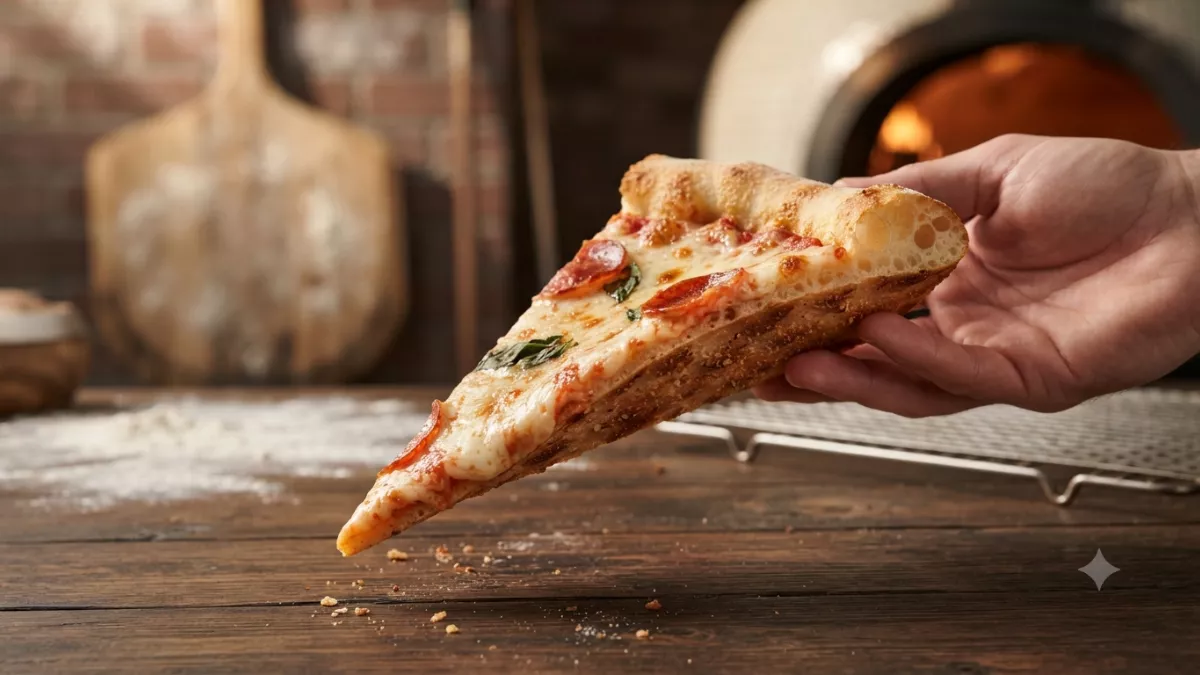
A great pizza slice has a surprisingly difficult job to do. It needs to be strong enough to hold sauce, cheese, and toppings without collapsing, yet crisp enough to provide that satisfying crunch when you take a bite. If a slice becomes floppy, soggy, or too soft, the entire eating experience changes.
So, what makes a pizza slice hold its shape without losing its crunch?
The answer comes down to several factors working together: the dough structure, gluten development, hydration, fermentation, crust thickness, baking temperature, moisture control, cheese, sauce, toppings, and the way the pizza is handled after it comes out of the oven.
A well-made pizza does not rely on one ingredient or technique. Its structure is the result of many small decisions that happen from dough preparation all the way to the final slice.
Why Does a Pizza Slice Need Structure?
A pizza slice has to support several layers at once.
At the bottom is the crust. Above it are sauce, cheese, and toppings. Every additional ingredient adds weight and moisture.
If the crust is too weak, the tip of the slice can bend dramatically when lifted. If the dough contains too much moisture or the toppings release too much water, the crust can lose its crispness.
The ideal slice has enough flexibility to bend slightly without completely folding over.
This balance between flexibility and strength is one of the defining characteristics of a well-made pizza.
The Role of Gluten in Pizza Dough
Gluten is one of the most important structural components of pizza dough.
When flour is mixed with water, proteins in the flour interact and form a gluten network. Kneading, folding, resting, and fermentation help develop this network.
A strong gluten structure gives the dough elasticity and helps it retain the gases produced during fermentation.
That structure contributes to:
- Stretchability
- Chewiness
- Strength
- Air retention
- Crust structure
- Resistance to tearing
Without adequate gluten development, a pizza crust may lack the strength needed to support its toppings.
However, extremely strong dough is not automatically better. Pizza dough needs the right balance between strength and extensibility so it can be shaped without becoming tough.
How Hydration Affects Slice Strength
Hydration refers to the amount of water in the dough relative to the flour.
Higher-hydration doughs contain more water and can produce lighter, airier textures when properly handled and baked.
Lower-hydration doughs generally produce firmer dough that can become crisp more easily.
The relationship is not simply “less water equals better crunch.” Baking temperature, flour, fermentation, dough thickness, and cooking time all influence the final result.
Too much moisture can make it harder to achieve a crisp base, especially if the pizza is heavily topped.
The goal is to create enough moisture for a desirable interior while allowing the exterior to dry and brown properly during baking.
Why Fermentation Matters
Fermentation does much more than add flavor.
During fermentation, yeast produces gases and other compounds that affect the dough’s structure and characteristics.
A properly fermented dough can develop:
- Better extensibility
- More complex flavor
- Improved texture
- A lighter internal structure
- Better browning potential
Poorly fermented dough can be difficult to shape and may produce a crust that is dense, weak, or lacking in flavor.
Longer fermentation does not automatically mean better pizza. The dough needs to be fermented appropriately for its formula, temperature, yeast quantity, and intended style.
How Crust Thickness Affects a Slice
Crust thickness has a major effect on structural strength.
A thin pizza has less dough supporting the toppings. This can create a crisp, delicate slice, but the dough must still have enough strength to carry the weight.
A thicker crust provides more structural material and can support heavier toppings.
However, thick crust does not automatically mean crisp crust. A thick pizza can have a soft or airy interior while still developing a browned, crisp exterior.
The ideal thickness depends on the style of pizza you are making.
The Importance of a Strong Bottom Crust
The bottom of the pizza acts like the foundation of a building.
It needs to support everything above it.
A properly baked bottom crust should have enough firmness to keep the slice together without becoming excessively hard.
This is where baking surface and oven heat become particularly important.
A pizza baked directly on a properly heated stone or steel can receive strong heat from below, helping the base develop color and structure.
A weakly heated baking surface may leave the bottom pale and soft even when the top looks finished.
Why High Heat Helps Create Crunch
Pizza is commonly baked at high temperatures because intense heat helps the dough transform quickly.
Several processes occur during baking:
- Water begins evaporating.
- Yeast activity increases before eventually stopping.
- Gases expand.
- The dough structure sets.
- Starches gelatinize.
- Proteins change structure.
- The crust browns.
- Surface moisture decreases.
The combination of moisture loss and browning contributes to crispness.
If the oven is not sufficiently hot, the pizza may spend too much time losing moisture without developing the desired structure and browning.
What Is the Difference Between Crunch and Crispness?
Although the terms are often used interchangeably, crunch and crispness can describe slightly different sensations.
Crispness usually refers to a firm surface that breaks easily when bitten.
Crunch often suggests a more noticeable cracking or breaking sensation.
A pizza can have a crisp exterior while retaining some chewiness inside.
That contrast is often desirable because it gives the slice multiple textures rather than making the entire crust hard.
How Sauce Can Make a Slice Soggy
Tomato sauce contains a significant amount of water.
If too much sauce is applied, that moisture can migrate into the dough during baking and make the center softer.
The problem becomes more noticeable when sauce is combined with several other high-moisture toppings.
A good pizza does not necessarily need a thick layer of sauce.
Instead, the sauce should be distributed evenly in a layer that provides flavor without overwhelming the crust.
The right amount depends on the crust style and pizza size.
How Cheese Affects Slice Structure
Cheese contributes both flavor and moisture.
Mozzarella melts into a cohesive layer that helps bind toppings together. This can actually make a slice easier to handle.
However, too much cheese can introduce excessive moisture and fat.
A heavily covered pizza may become difficult to crisp properly because the surface is insulated by the toppings.
The type of mozzarella also matters.
Low-moisture mozzarella generally produces a different texture from fresh mozzarella. Fresh mozzarella contains more water and may need to be drained before being used on pizza.
Why Topping Weight Matters
A crust can only support so much weight before its structure becomes compromised.
Imagine a thin pizza loaded with:
- Heavy sausage
- Bacon
- Mushrooms
- Extra cheese
- Olives
- Thick tomato sauce
Even if the crust itself is well made, the accumulated weight can cause the slice to bend.
The solution is not necessarily to eliminate toppings. Instead, use reasonable quantities and distribute them evenly.
A balanced topping load allows the crust to perform its structural job.
Moisture Is the Enemy of Crunch
If you want a crunchy pizza slice, moisture control is essential.
Common high-moisture ingredients include:
- Fresh tomatoes
- Fresh mozzarella
- Mushrooms
- Spinach
- Pineapple
- Zucchini
- Certain sauces
This does not mean these ingredients should be avoided.
Instead, they should be prepared appropriately.
For example, mushrooms can be sautéed before baking. Fresh mozzarella can be drained. Pineapple can be patted dry. Spinach can be wilted or used in controlled quantities.
Reducing excess water helps the crust stay crisp.
How Mushrooms Affect Pizza Crunch
Mushrooms contain a lot of water.
When raw mushrooms are placed on pizza, they release moisture as they heat.
That moisture can soften the surrounding crust.
Pre-cooking mushrooms helps remove some of that water before they reach the pizza.
It also intensifies their flavor and creates a more concentrated texture.
For a crisp pizza, this small preparation step can make a noticeable difference.
Why Topping Distribution Matters
Where toppings are placed can affect the structural integrity of a slice.
If the center contains a huge pile of toppings while the outer area has very little, the slice becomes unevenly weighted.
Spread toppings relatively evenly across the surface while leaving enough room around the edge for the crust to develop.
Even distribution also improves cooking because ingredients receive more consistent exposure to heat.
The Role of the Pizza Edge
The outer crust provides structural support around the perimeter of the pizza.
A well-developed edge can help create a stronger overall structure while providing a satisfying contrast to the thinner center.
Different pizza styles handle this differently.
Some styles have a narrow, crisp edge. Others have a thick, airy rim.
The important factor is that the edge should be appropriately developed for the style rather than simply being as large as possible.
Why New York-Style Pizza Can Fold Without Falling Apart
New York-style pizza is a useful example of structural balance.
A typical New York-style slice is thin enough to remain relatively light but strong enough to support sauce, cheese, and toppings.
The crust can bend when folded while still maintaining enough structural integrity to prevent complete collapse.
That combination comes from the dough formula, fermentation, shaping, baking, and topping balance rather than from thickness alone.
How Shaping Affects Slice Structure
The way pizza dough is shaped can influence its final texture.
Stretching dough too aggressively can create weak areas.
Uneven thickness can also produce inconsistent cooking.
A controlled shaping process helps create a relatively even center while preserving the desired edge structure.
Avoid repeatedly pressing all the gas out of a dough if you want an airy rim.
At the same time, the center needs to be thin enough for the style and topping load.
Why the Baking Surface Matters
A pizza stone or steel can provide strong conductive heat to the bottom of the dough.
This helps the crust set and brown from below.
A regular baking sheet can still produce good pizza, but the heat transfer characteristics are different.
The key is not the name of the equipment but how effectively it transfers heat to the dough.
A properly preheated surface is particularly important for thin-crust pizza.
Why Preheating Matters
Putting pizza onto a cold or insufficiently heated surface can delay the formation of the bottom crust.
During that extra time, sauce and toppings can release moisture into the dough.
The result may be a pale or soft base.
Allowing the oven and baking surface to fully preheat gives the dough a better chance to develop its crust before excessive moisture has time to penetrate.
How Baking Time Affects Crunch
Baking time has a major effect on texture.
Too little baking time can leave the center soft and underdeveloped.
Too much baking time can make the crust excessively dry or hard.
The ideal point depends on:
- Dough thickness
- Oven temperature
- Hydration
- Topping quantity
- Baking surface
- Pizza size
Look for visual signs such as a browned bottom, properly cooked edges, melted cheese, and a crust that feels firm enough to support the toppings.
Why Slicing Immediately Can Affect Texture
Once the pizza comes out of the oven, it continues to change.
Steam and heat remain trapped within the crust and toppings.
If the pizza is immediately stacked or covered, steam can soften the crust.
Allowing the pizza to sit briefly on a suitable surface can help excess steam escape.
However, you generally do not want to leave it sitting for a long time because the pizza will gradually cool and lose some of its desirable texture.
How to Keep a Pizza Slice Crunchy
If you want your pizza to retain its crunch, focus on moisture and heat management.
Useful practices include:
- Fully preheat the oven.
- Use a properly heated baking surface.
- Avoid excessive sauce.
- Control high-moisture toppings.
- Drain fresh mozzarella.
- Pre-cook watery vegetables when appropriate.
- Avoid excessive cheese.
- Distribute toppings evenly.
- Bake until the bottom is properly browned.
- Avoid trapping steam after baking.
Each step contributes to the final texture.
Can a Pizza Be Crispy and Flexible at the Same Time?
Yes.
In fact, many popular pizza styles are designed around this exact combination.
The crust can have a crisp outer surface while maintaining a flexible and chewy interior.
This happens when the exterior loses enough moisture and browns properly while the interior retains some moisture and remains structurally flexible.
The result is a slice that can bend without becoming completely floppy.
Why Some Pizza Slices Collapse in the Middle
A collapsing tip is usually related to some combination of:
- Excess moisture
- Too many toppings
- Weak dough structure
- Underbaking
- Excessive sauce
- High-moisture cheese
- Insufficient bottom heat
The exact cause can vary.
If the crust itself feels well baked but the center still collapses, look closely at the sauce and topping load.
If the entire crust feels soft, the issue may be related to baking temperature, baking surface, or dough formulation.
How to Build a Strong, Crispy Pizza Slice at Home
Start with properly fermented dough.
Shape it evenly, keeping the center appropriate for your preferred pizza style.
Apply a moderate amount of sauce, followed by a controlled amount of cheese and toppings.
If using ingredients that release a lot of water, prepare them beforehand.
Bake on a thoroughly heated surface in a hot oven.
When the pizza is finished, check the underside. It should have developed enough color and firmness to support the slice.
Let excess steam escape briefly before cutting and serving.
This process gives you a better chance of achieving the ideal combination of structure and crunch.
The Ideal Balance: Crisp Outside, Chewy Inside
Many people associate great pizza with contrast.
The crust should not necessarily be crunchy from edge to center.
Instead, the exterior can provide crispness while the interior provides chewiness.
The toppings can add creaminess, saltiness, acidity, sweetness, or spice.
The cheese can be stretchy and rich.
The sauce can contribute moisture and acidity.
When all these elements are balanced, the slice feels sturdy without becoming rigid.
Common Mistakes That Destroy Pizza Crunch
Too Much Sauce
Excess sauce adds moisture and can soften the center.
Too Many Wet Toppings
Several high-moisture vegetables can release enough water to compromise crispness.
Overloading With Cheese
A thick layer of cheese can prevent the surface from drying and browning properly.
Underheated Oven
Insufficient heat can leave the bottom pale and soft.
Cold Baking Surface
The dough takes longer to set, increasing the chance of moisture absorption.
Overloading the Center
A heavy center can cause the slice to bend or collapse.
Covering Hot Pizza
Trapping steam can soften the crust.
Final Thoughts
A pizza slice holds its shape without losing its crunch because several elements work together.
The dough needs enough gluten structure to provide strength. Fermentation needs to develop the right texture. Hydration must be balanced with the desired crust style. The oven and baking surface need to provide enough heat to set and brown the bottom. Sauce, cheese, and toppings need to be used in quantities that do not overwhelm the crust with weight or moisture.
The best pizza slice is rarely the hardest or crispiest one. Instead, it often has contrast: a browned exterior, a slightly chewy interior, flavorful toppings, melted cheese, and enough structural strength to hold everything together.
When these elements are balanced, you get that satisfying experience of picking up a slice that stays intact while still delivering a crisp, flavorful bite.
Frequently Asked Questions
What makes a pizza slice hold its shape?
A strong gluten network, proper fermentation, appropriate crust thickness, sufficient baking, and controlled topping weight all contribute to a pizza slice that holds its shape.
Why does pizza become soggy?
Pizza can become soggy because of excessive sauce, high-moisture toppings, fresh cheese, insufficient baking, or inadequate heat from the baking surface.
How do you make pizza crust crispy?
Use a thoroughly preheated oven and baking surface, control moisture, avoid excessive toppings, and bake until the bottom develops adequate browning and firmness.
Does more cheese make pizza less crispy?
It can. Excessive cheese adds moisture and fat and can create a thick layer that slows moisture loss from the surface.
Why does my pizza slice bend in the middle?
A bending or collapsing center can result from excess moisture, heavy toppings, too much sauce, underbaking, or insufficient structural strength in the dough.