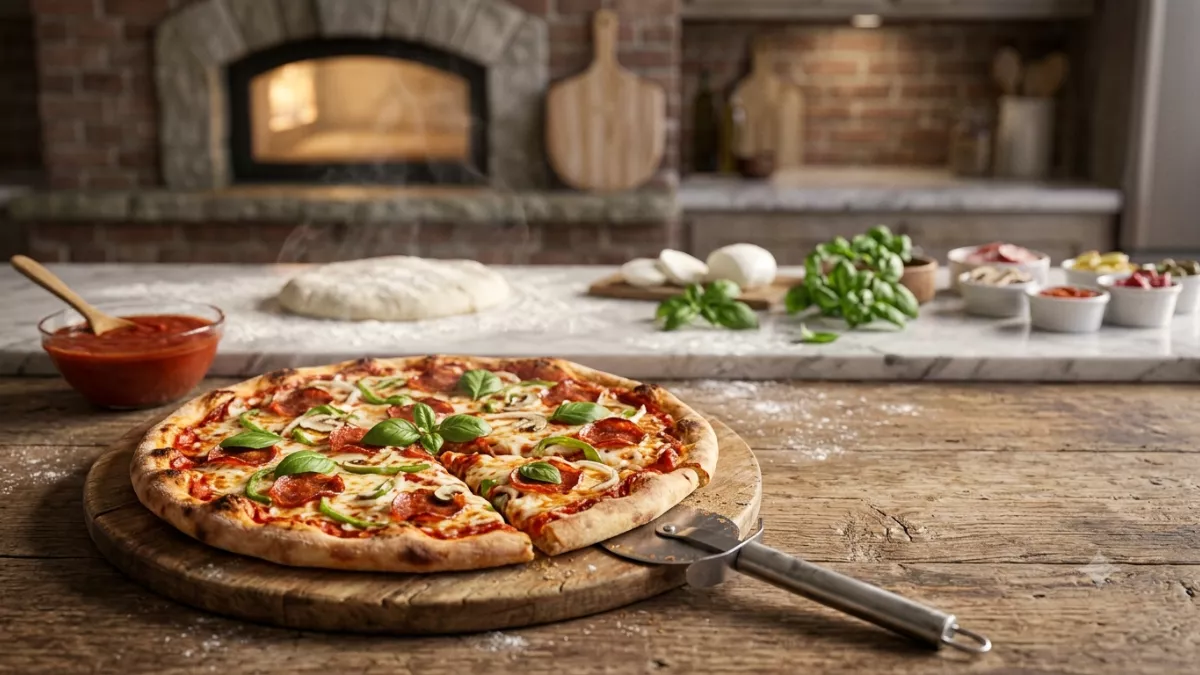
There is something special about restaurant-style pizza. The crust is crisp on the outside but tender and chewy inside, the cheese melts beautifully, the sauce has plenty of flavor, and the toppings are perfectly balanced.
The good news is that you don’t need a professional restaurant kitchen to make impressive pizza at home.
With the right dough, quality ingredients, proper preparation, and plenty of heat, you can create a homemade pizza that tastes and feels much closer to what you would expect from a good pizzeria.
The biggest secret is understanding that great pizza is not simply about adding more cheese or toppings. Dough fermentation, oven temperature, moisture control, ingredient quality, and baking technique all play important roles.
In this guide, you’ll learn how to make restaurant-style pizza at home from start to finish, including the dough, sauce, cheese, toppings, oven setup, baking process, and common mistakes to avoid.
What Makes Restaurant-Style Pizza Different?
Restaurant pizza can vary dramatically depending on the style and restaurant, but several characteristics commonly make a pizza feel professionally prepared.
A good pizza usually has:
- A flavorful, well-developed crust
- A crisp exterior
- A soft or chewy interior
- Balanced tomato sauce
- Properly melted cheese
- Fresh or high-quality toppings
- Controlled moisture
- Strong heat during baking
- A good balance between toppings and crust
One of the biggest differences between homemade and restaurant pizza is often oven temperature.
Professional pizza ovens can reach temperatures much higher than many conventional home ovens. A hotter cooking environment allows the crust to brown quickly while the toppings cook without leaving the center soggy.
You can still get excellent results at home by maximizing the heat available from your oven and using equipment such as a pizza stone or baking steel.
Ingredients for Restaurant-Style Pizza
You don’t need an enormous ingredient list.
For the dough
- 3 cups bread flour or high-protein flour
- 1 teaspoon instant yeast
- 1 teaspoon salt
- 1 teaspoon sugar, optional
- 1 tablespoon olive oil
- About 1 to 1¼ cups lukewarm water
The exact amount of water can vary depending on the flour and environmental conditions.
For the pizza sauce
- 1 cup crushed tomatoes
- 1 tablespoon olive oil
- 1 small garlic clove, finely minced
- ½ teaspoon dried oregano
- ½ teaspoon dried basil
- Salt to taste
- Small pinch of sugar, optional
For the toppings
- 1½ to 2 cups shredded low-moisture mozzarella
- Pepperoni, sausage, mushrooms, onions, or vegetables of your choice
- Fresh basil, optional
- Parmesan, optional
- Olive oil, optional
The most important principle is quality over quantity. A few good ingredients can produce a better pizza than a dozen mediocre toppings.
Step 1: Make the Pizza Dough
The dough is the foundation of your pizza.
Start by combining the flour, yeast, salt, and optional sugar in a large mixing bowl.
Gradually add the water while mixing.
Once the dough begins to come together, add the olive oil and continue mixing until you have a rough dough.
Transfer the dough to a lightly floured surface and knead it for approximately 8 to 10 minutes.
You want the finished dough to become smoother and more elastic.
It should feel soft and slightly tacky rather than extremely sticky.
Why kneading matters
Kneading develops gluten, which gives pizza dough its structure.
Well-developed gluten helps the dough stretch without immediately tearing and contributes to the chewy texture associated with many restaurant-style pizzas.
Avoid adding large amounts of extra flour simply because the dough feels slightly sticky.
Too much flour can produce a dense crust.
Step 2: Let the Dough Ferment
This is one of the most important steps for improving homemade pizza.
Place the dough in a lightly oiled bowl and cover it.
Allow it to rest until it has expanded and become noticeably softer and more relaxed.
For even more flavor, consider cold fermentation.
After mixing and kneading, place the covered dough in the refrigerator for approximately 24 to 72 hours. Before baking, allow it to come back toward room temperature so that it becomes easier to stretch.
Longer fermentation can contribute to more developed flavor and a different dough texture, although the ideal fermentation time depends on the recipe, yeast quantity, flour, and refrigerator temperature.
If you’re making pizza tonight, a shorter room-temperature rise can still produce a delicious result.
Step 3: Prepare the Pizza Sauce
Restaurant-style pizza usually doesn’t need an overly complicated sauce.
Combine crushed tomatoes with olive oil, garlic, oregano, basil, and salt.
Taste the sauce and adjust the seasoning.
For many pizza styles, you don’t need to cook the sauce for a long time before putting it on the dough.
A simple tomato sauce can allow the flavor of the crust, cheese, and toppings to remain noticeable.
Don’t use too much sauce
One of the most common homemade pizza mistakes is adding a thick layer of sauce.
A thin, even layer is usually enough.
Too much sauce adds moisture and can prevent the center of the pizza from becoming properly crisp.
Step 4: Choose the Right Cheese
Cheese is another major component of restaurant-style pizza.
Low-moisture mozzarella is particularly convenient for many homemade pizzas because it melts well while introducing less water than very wet fresh mozzarella.
You can also experiment with combinations such as:
- Mozzarella + Parmesan
- Mozzarella + provolone
- Mozzarella + ricotta
- Mozzarella + a small amount of cheddar
However, more cheese isn’t necessarily better.
Too much cheese can make the pizza greasy and heavy while increasing moisture in the center.
Spread the cheese evenly so every slice receives a balanced amount.
Step 5: Choose Your Toppings
This is where you can customize your pizza.
Some popular choices include:
Meat toppings
- Pepperoni
- Italian sausage
- Cooked chicken
- Bacon
- Ham
- Meatballs
Vegetable toppings
- Mushrooms
- Onions
- Bell peppers
- Spinach
- Tomatoes
- Olives
- Jalapeños
Finishing ingredients
- Fresh basil
- Arugula
- Parmesan
- Chili flakes
- Garlic oil
- Hot honey
Try to avoid putting too many toppings on one pizza.
A restaurant-style pizza generally benefits from balance.
For example:
Pepperoni + mushrooms + mozzarella
is simple but flavorful.
Another option is:
Italian sausage + onions + bell peppers
for a richer savory pizza.
For a vegetarian pizza, try:
Mushrooms + peppers + onions + spinach + mozzarella.
Step 6: Preheat Your Oven Properly
This may be the most important step for getting better homemade pizza.
Set your oven to its highest appropriate baking temperature according to the manufacturer’s instructions.
Allow it to preheat thoroughly.
If you’re using a pizza stone or baking steel, place it in the oven during preheating so the cooking surface becomes extremely hot.
A hot cooking surface helps the dough begin baking immediately when it reaches the oven.
Pizza stone vs. baking steel
Both can improve homemade pizza.
A pizza stone stores heat and transfers it to the dough.
A baking steel conducts heat very efficiently and can be particularly useful when you want strong bottom heat.
If you don’t have either, you can still make pizza on a heavy baking sheet.
For the best results, however, a properly preheated pizza stone or steel can make a noticeable difference.
Step 7: Shape the Dough
When the dough has finished fermenting and is relaxed enough to stretch, place it on a lightly floured surface.
Gently press from the center toward the outside.
Leave a slightly thicker border around the edge for the crust.
Instead of aggressively flattening the entire dough, work gradually.
You can stretch the dough by hand or use a rolling pin depending on the pizza style you’re making.
For a more airy, hand-shaped crust, gentle hand stretching is often preferred.
Try to avoid pressing all the air out of the outer edge.
Step 8: Build Your Pizza
Transfer the stretched dough to a pizza peel or another surface suitable for launching it into the oven.
Add:
- A thin layer of sauce
- An even layer of cheese
- Your selected toppings
- Optional finishing ingredients
Don’t spend too long assembling the pizza on a surface where it could stick.
A lightly floured or appropriately prepared pizza peel can make transferring the pizza easier.
Step 9: Bake the Pizza
Carefully transfer the pizza onto the preheated stone or steel.
Bake until:
- The crust is browned
- The cheese is melted
- The toppings are cooked
- The bottom has developed the desired crispness
The exact cooking time depends heavily on your oven temperature, pizza thickness, toppings, and equipment.
Rather than relying only on a timer, learn to judge the pizza visually.
The crust should look properly baked rather than pale or doughy.
If the top needs more browning, you can finish the pizza under the oven’s broiler for a short period if your oven and cookware allow it.
Watch it carefully because cheese can brown quickly.
Step 10: Finish the Pizza
Once the pizza comes out of the oven, give it a minute or two before slicing.
Then add finishing ingredients if desired.
Try:
- Fresh basil
- Parmesan
- Chili flakes
- Extra virgin olive oil
- Garlic oil
- Hot honey
- Fresh arugula
These ingredients can add aroma and contrast without requiring additional cooking.
Slice the pizza and serve immediately.
How to Get a Crispy Pizza Crust at Home
If your homemade pizza consistently has a soft or soggy bottom, several factors may be responsible.
Use less moisture
Too much sauce, cheese, or watery vegetables can make the center wet.
Drain ingredients such as canned pineapple and olives, and consider pre-cooking moisture-heavy vegetables.
Preheat the cooking surface
A cold baking tray doesn’t provide the same immediate heat as a thoroughly preheated stone or steel.
Avoid overloading the pizza
A mountain of toppings can prevent the center from baking properly.
Use a moderate amount of each ingredient.
Bake at high heat
Pizza generally benefits from strong heat.
Your home oven may not reach the temperatures of a commercial pizza oven, but using its highest appropriate setting and a properly preheated baking surface can improve the result.
How to Make Pizza Taste More Like a Restaurant
Sometimes the difference isn’t the ingredients—it’s the technique.
1. Ferment the dough
Give the dough enough time to develop flavor and structure.
2. Use good-quality flour
Bread flour or another suitable high-protein flour can provide useful gluten development and chew.
3. Don’t overload the sauce
A light coating keeps the crust from becoming wet.
4. Use balanced toppings
Each ingredient should have a purpose.
5. Preheat thoroughly
Heat is essential for good crust development.
6. Finish with fresh ingredients
Fresh basil, herbs, olive oil, or Parmesan can add restaurant-style finishing touches.
Common Homemade Pizza Mistakes
Using too much flour
Extra flour can make the dough dense and dry.
Use just enough flour to make the dough manageable.
Skipping fermentation
Very quickly prepared dough can work, but fermentation often contributes to better flavor and texture.
Adding too many toppings
More toppings can mean more moisture and a heavier center.
Using cold cooking equipment
A pizza placed onto a cold surface may take longer to develop a crisp bottom.
Cutting immediately
Allowing the pizza to rest briefly after baking can make slicing easier and reduce the chance of immediately losing all of the melted cheese and toppings.
Easy Restaurant-Style Pizza Combination Ideas
Classic Pepperoni
Tomato sauce + mozzarella + pepperoni + Parmesan
A simple combination that highlights the crust and cheese.
Mushroom and Sausage
Tomato sauce + mozzarella + Italian sausage + mushrooms + onions
Rich, savory, and satisfying.
Margherita-Style
Tomato sauce + mozzarella + fresh tomatoes + basil + olive oil
A relatively simple pizza that depends heavily on ingredient quality.
Spicy Chicken
Tomato sauce + mozzarella + cooked chicken + jalapeños + chili flakes
A good choice for anyone who enjoys heat.
BBQ Chicken
Barbecue sauce + mozzarella + cooked chicken + red onion
A different flavor profile from traditional tomato-based pizza.
Frequently Asked Questions
What temperature is best for making pizza at home?
Use the highest appropriate temperature your oven is designed to safely maintain. A thoroughly preheated oven, especially when combined with a pizza stone or steel, can help produce a better crust.
How long should pizza dough ferment?
Pizza dough can be fermented for different lengths of time depending on the recipe. A short room-temperature fermentation can work for same-day pizza, while a 24- to 72-hour refrigerated fermentation is often used when developing additional flavor and texture.
Should I use a pizza stone or steel?
Both can work well. A pizza stone stores heat effectively, while baking steel conducts heat very efficiently. Either can be useful for improving the bottom crust of homemade pizza.
Why is my homemade pizza soggy?
Common causes include too much sauce, excessive cheese, wet toppings, insufficient oven heat, or an inadequately preheated baking surface.
What flour is best for homemade restaurant-style pizza?
Bread flour or another pizza-appropriate flour can work well because its protein content can support a stretchy, chewy dough. The best flour also depends on the pizza style and recipe.
Final Thoughts
Making restaurant-style pizza at home is less about finding one secret ingredient and more about mastering a few fundamental techniques.
Start with a well-made dough, give it enough time to ferment, use a flavorful but restrained sauce, choose quality cheese, and avoid overwhelming the pizza with toppings.
Then focus on heat.
A thoroughly preheated oven and pizza stone or baking steel can help you get closer to the crisp, browned crust associated with professional pizza kitchens.
Once you understand the fundamentals, you can experiment with different dough styles, sauces, cheeses, meats, vegetables, and finishing ingredients.
Whether you prefer classic pepperoni, sausage and peppers, mushroom pizza, or a simple Margherita-style pie, homemade pizza gives you complete control over the ingredients.
With a little practice, your kitchen can become your own pizza shop—and pizza night can become one of the easiest meals to look forward to.