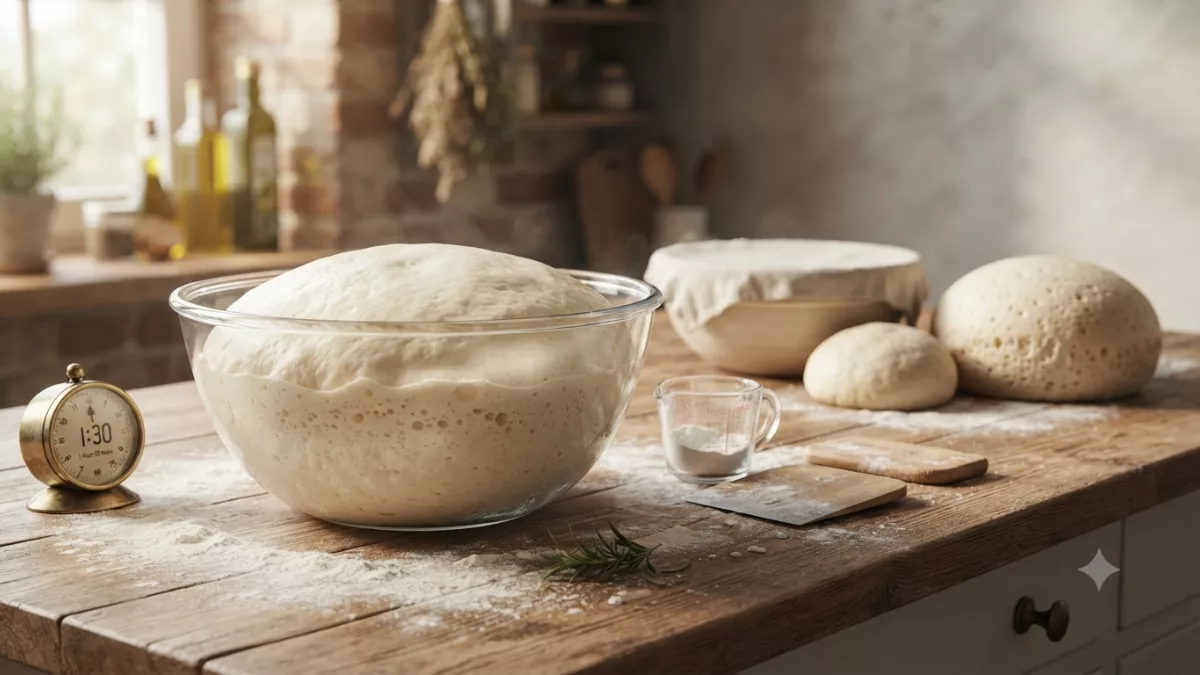
Making homemade pizza starts with one of the most important ingredients: the dough.
You can have excellent sauce, quality cheese, and delicious toppings, but if the dough isn’t properly fermented, the finished pizza may be dense, tough, or lacking flavor.
One of the most common questions beginners ask is: How long does pizza dough need to rise?
The short answer is that it depends on the recipe, yeast, temperature, flour, and fermentation method. A typical pizza dough may need around 1 to 2 hours for a warm first rise, while a slower refrigerator fermentation can take 24 to 72 hours.
However, time alone doesn’t determine whether your dough is ready.
Understanding what happens during fermentation, how temperature affects yeast, and how to recognize properly risen dough will help you make better pizza at home.
In this complete guide, we’ll explain how long pizza dough needs to rise, the difference between rising and proofing, common mistakes, refrigerator fermentation, and how to tell when your dough is ready to use.
What Does It Mean When Pizza Dough Rises?
When pizza dough rises, yeast consumes available sugars and produces carbon dioxide gas.
The gas becomes trapped within the developing gluten structure of the dough.
As a result, the dough expands and becomes lighter and more airy.
Fermentation also produces compounds that contribute to the dough’s flavor and aroma.
That’s why properly fermented pizza dough can taste significantly better than dough that has been rushed.
The rising process therefore does two important things:
- It increases the dough’s volume.
- It develops flavor and texture.
How Long Does Pizza Dough Need to Rise?
There isn’t one exact rising time that works for every pizza dough.
As a general guide:
| Fermentation Method | Approximate Time |
|---|---|
| Warm room-temperature rise | 1–2 hours |
| Moderate room-temperature fermentation | 2–4 hours |
| Overnight refrigerator fermentation | 12–24 hours |
| Slow cold fermentation | 24–72 hours |
These are general ranges rather than strict rules.
A dough can rise faster in a warm kitchen and much more slowly in a cool environment.
The amount of yeast also matters.
A recipe containing more yeast generally ferments faster than one using a small amount of yeast.
1. Quick Pizza Dough: About 1–2 Hours
If you want pizza the same day, a relatively short fermentation can work.
Many simple homemade pizza dough recipes use enough yeast to produce noticeable expansion within approximately one to two hours at a warm room temperature.
A basic process might look like this:
- Mix flour, water, yeast, salt, and other ingredients.
- Knead or mix until the dough develops structure.
- Place the dough in a lightly oiled bowl.
- Cover it.
- Allow it to rise at room temperature.
- Shape it into dough balls.
- Let the balls rest again before stretching.
The exact timing depends on the recipe and room temperature.
Advantages of a quick rise
- Pizza can be made the same day.
- The process is straightforward.
- It requires less planning.
- It works well for casual pizza nights.
Potential downside
A very short fermentation may produce less complex flavor than a slower fermentation.
2. Overnight Pizza Dough: About 12–24 Hours
If you have more time, overnight fermentation can be an excellent option.
Instead of using a large amount of yeast and rushing the dough, you can use a smaller quantity and allow fermentation to happen more slowly.
The dough is typically placed in the refrigerator.
Cold temperatures slow yeast activity.
This allows fermentation to continue gradually while giving the dough time to develop flavor.
A typical overnight process
Day 1:
- Mix the dough.
- Allow a short initial fermentation if your recipe calls for it.
- Divide into portions.
- Place covered dough balls in the refrigerator.
Day 2:
- Remove the dough from the refrigerator.
- Allow it to warm and relax before shaping.
- Stretch the dough.
- Add sauce and toppings.
- Bake.
The result can be a more flavorful and pleasantly textured crust.
3. Long Fermentation: 24–72 Hours
For even more developed flavor, some pizza dough recipes use cold fermentation for one to three days.
This approach is popular among home pizza enthusiasts because it can produce dough with greater flavor complexity.
The yeast works slowly in the refrigerator.
Meanwhile, enzymes in the dough continue to affect the flour’s structure and contribute to the characteristics of the finished crust.
Why use a longer fermentation?
Longer fermentation can provide:
- More developed flavor
- Improved aroma
- A more complex crust
- Convenient preparation ahead of time
- Better control over pizza-day preparation
However, longer isn’t automatically better.
If the dough ferments for too long or is poorly managed, it can become over-fermented and difficult to work with.
What Temperature Is Best for Pizza Dough to Rise?
Temperature has a major effect on fermentation speed.
In general:
Warmer environment = faster fermentation
Cooler environment = slower fermentation
A warm kitchen can cause dough to rise significantly faster than a cool kitchen.
This is why using a recipe’s exact timing without considering room temperature can sometimes lead to problems.
For example, dough that normally takes two hours in a moderately warm kitchen may rise much faster in a very warm environment.
Conversely, the same dough may take considerably longer during cold weather.
How Can You Tell When Pizza Dough Is Ready?
This is more important than watching the clock.
Instead of relying entirely on time, look at the dough.
Properly risen pizza dough generally becomes:
- Noticeably larger
- Softer
- Airier
- More relaxed
- Slightly puffy
- Easier to stretch
The exact appearance depends on the recipe and fermentation method.
The finger-poke test
One commonly used method is the finger-poke test.
Gently press a finger into the dough.
If the indentation slowly springs back, the dough may be appropriately fermented.
If it immediately springs back completely, it may need more time.
If the dough collapses easily or the indentation remains dramatically, it may be over-proofed.
This test isn’t perfect, but it can help when combined with the dough’s appearance and feel.
What Happens If Pizza Dough Doesn’t Rise?
If your dough barely expands, something may be interfering with fermentation.
Possible causes include:
1. Inactive yeast
Old or improperly stored yeast may not work effectively.
2. Water temperature problems
Extremely hot water can damage yeast.
Very cold water can slow fermentation significantly.
3. Cold room temperature
A cool kitchen can make fermentation much slower.
4. Too much salt
Salt affects yeast activity, so excessive amounts can interfere with fermentation.
5. Incorrect measurements
Too much flour can produce a stiff dough that doesn’t expand easily.
6. Insufficient fermentation time
Sometimes the dough simply needs more time.
What Happens If Pizza Dough Rises Too Long?
Pizza dough can also go too far.
Over-fermented dough may become:
- Very loose
- Weak
- Difficult to shape
- Excessively sticky
- Flat after handling
- Less elastic
The dough may also develop an overly fermented smell or lose its ability to hold structure effectively.
If you suspect your dough has gone too far, don’t automatically throw it away.
Depending on the recipe and degree of fermentation, it may still be possible to reshape it and use it, although the final result may not be ideal.
Should Pizza Dough Rise Twice?
Many pizza recipes involve more than one fermentation stage.
A common process is:
First rise
The entire dough ferments together.
Division
The dough is divided into individual portions.
Second rise
The portions rest and ferment again before baking.
The second stage is particularly useful because individual dough balls have time to relax.
Relaxed dough is generally easier to stretch without excessive resistance.
Why Does Pizza Dough Need to Rest After Balling?
After dough is divided and shaped into balls, the gluten structure can be relatively tight.
If you immediately try to stretch the dough, it may repeatedly shrink back.
Resting allows the gluten network to relax.
As a result, the dough can become:
- Easier to stretch
- More flexible
- Less resistant
- Easier to shape evenly
This is one reason experienced pizza makers don’t rush directly from mixing to stretching.
Room-Temperature vs. Refrigerator Fermentation
Both methods can produce good pizza.
Room-temperature fermentation
Advantages:
- Faster
- Simple
- Convenient for same-day pizza
Disadvantages:
- Less forgiving
- Fermentation can speed up quickly in warm conditions
- Requires closer attention
Refrigerator fermentation
Advantages:
- Slower and more controlled
- Convenient for advance preparation
- Can develop more complex flavor
- Useful for pizza-making schedules
Disadvantages:
- Requires planning
- Dough needs time to warm and relax
- Fermentation can still go too far if stored excessively long
How to Store Pizza Dough in the Refrigerator
If you’re planning to ferment pizza dough overnight or longer, proper storage is important.
Place individual dough balls in covered containers.
Make sure the dough doesn’t dry out.
An airtight container or tightly covered dough tray can help prevent the surface from forming a dry skin.
Before baking, remove the dough from the refrigerator according to your recipe’s instructions and allow it enough time to become workable.
Avoid leaving it uncovered.
How Long Should Pizza Dough Sit Out Before Baking?
After cold fermentation, pizza dough often needs time at room temperature before shaping.
A common range is approximately 1–2 hours, although this varies considerably depending on dough temperature, room temperature, recipe, and fermentation level.
The goal isn’t simply to make the dough warm.
You want the dough to become relaxed and workable.
If the dough is still extremely cold and tight, it may resist stretching.
If it becomes excessively warm and continues fermenting for too long, it can become difficult to handle.
Does More Yeast Make Better Pizza?
Not necessarily.
More yeast generally increases fermentation speed, but that doesn’t automatically mean better flavor.
A pizza dough with a relatively small amount of yeast and a longer fermentation can develop a different flavor and texture than a dough made with more yeast and a short rise.
The best amount depends on:
- Fermentation duration
- Temperature
- Flour
- Hydration
- Desired pizza style
- Baking schedule
The goal is controlled fermentation rather than simply maximizing yeast activity.
Does Flour Type Affect Rising Time?
Yes.
Different flours have different protein levels and characteristics.
Bread flour, pizza flour, and all-purpose flour can behave differently during fermentation and shaping.
Higher-protein flour can provide stronger gluten development, which can influence dough structure.
Whole-wheat flour can also behave differently because of its bran and germ content.
If you’re changing flour types, don’t assume the same dough timing will produce identical results.
Does Salt Affect Pizza Dough Rising?
Yes.
Salt plays several important roles in dough.
It contributes to:
- Flavor
- Gluten strength
- Fermentation control
Salt generally slows yeast activity.
This is useful because controlled fermentation is desirable for pizza dough.
However, the salt should be measured accurately according to the recipe.
What Is the Best Fermentation Time for Homemade Pizza?
For beginners, a same-day 1–2 hour rise can be a convenient starting point.
If you want to experiment with more developed flavor, try an overnight refrigerator fermentation.
For advanced home pizza makers, a 24–72 hour cold fermentation can be an interesting technique to explore.
There is no single universally perfect fermentation time.
The best timing is the one that produces dough with the flavor, texture, and handling characteristics you want.
Common Pizza Dough Rising Mistakes
Mistake 1: Following the clock blindly
Two hours isn’t always two hours.
Temperature changes fermentation speed.
Mistake 2: Using too much yeast
More yeast isn’t necessarily better.
Mistake 3: Using very hot water
Excessively hot water can damage yeast.
Mistake 4: Leaving dough uncovered
This can cause the surface to dry out.
Mistake 5: Not allowing dough to relax
Dough that hasn’t rested sufficiently can be difficult to stretch.
Mistake 6: Over-fermenting
Long fermentation needs proper temperature and yeast control.
Mistake 7: Adding too much flour during shaping
Excess flour can make the finished crust heavier and affect its texture.
A Simple Pizza Dough Fermentation Schedule
If you’re planning pizza for Saturday evening, you could use a schedule like this:
Thursday evening
Prepare the dough.
Thursday night
Divide into dough balls and refrigerate.
Friday
Allow the dough to continue cold fermentation.
Saturday afternoon
Remove the dough from the refrigerator according to your recipe’s timing.
Allow it to warm and relax.
Saturday evening
Stretch, top, and bake the pizzas.
This type of schedule allows you to prepare the dough well ahead of dinner.
How to Get a Better Pizza Crust Through Fermentation
Fermentation is only one part of making good pizza, but it has a major influence on the finished crust.
For better results:
- Measure ingredients accurately.
- Use fresh yeast.
- Don’t rush fermentation unnecessarily.
- Keep dough covered.
- Monitor temperature.
- Give dough time to relax.
- Avoid excessive handling.
- Preheat your oven thoroughly.
- Bake on a hot surface when possible.
Remember that fermentation and baking work together.
Excellent fermentation cannot completely compensate for an oven that isn’t hot enough.
Frequently Asked Questions
How long should pizza dough rise at room temperature?
A typical same-day pizza dough may take around 1–2 hours to rise in a warm environment, but the exact time depends on yeast quantity, temperature, flour, and recipe.
Can pizza dough rise overnight?
Yes. Pizza dough can be fermented overnight, usually in the refrigerator. Cold fermentation slows yeast activity and can help develop flavor.
Is 24 hours too long for pizza dough?
Not necessarily. Many pizza dough recipes are designed for 24-hour cold fermentation. The yeast quantity and storage temperature need to be appropriate for the longer fermentation.
Can pizza dough rise for 3 days?
Yes, some recipes use cold fermentation for up to 72 hours. However, the recipe needs to be designed for long fermentation, usually with a controlled amount of yeast.
How do I know if pizza dough has risen enough?
Look for increased volume, a softer and airier texture, and dough that feels relaxed and workable. A gentle finger-poke test can also provide a useful indication.
Why is my pizza dough not rising?
Inactive yeast, cold temperatures, incorrect measurements, excessive salt, or insufficient fermentation time can all contribute to slow or unsuccessful rising.
Can I put pizza dough in the refrigerator immediately?
Some recipes refrigerate the dough soon after mixing, while others use a short room-temperature fermentation first. Follow the method specified by your recipe.
Final Thoughts
So, how long does pizza dough need to rise?
For a quick homemade pizza, approximately 1–2 hours at room temperature may be enough for a dough to show significant fermentation.
For more developed flavor, an overnight or 24–72 hour refrigerator fermentation can be used with a suitable recipe.
The most important lesson is that pizza dough should be judged by its condition, not just the clock.
Temperature, yeast quantity, flour, hydration, and fermentation method all influence how quickly dough develops.
Once you learn to recognize dough that is properly fermented—soft, airy, relaxed, and easy to stretch—you’ll have much more control over your homemade pizza.
Give your dough enough time, avoid rushing the process, and pay attention to how it looks and feels.
A great pizza starts long before it enters the oven. It starts with properly fermented dough.