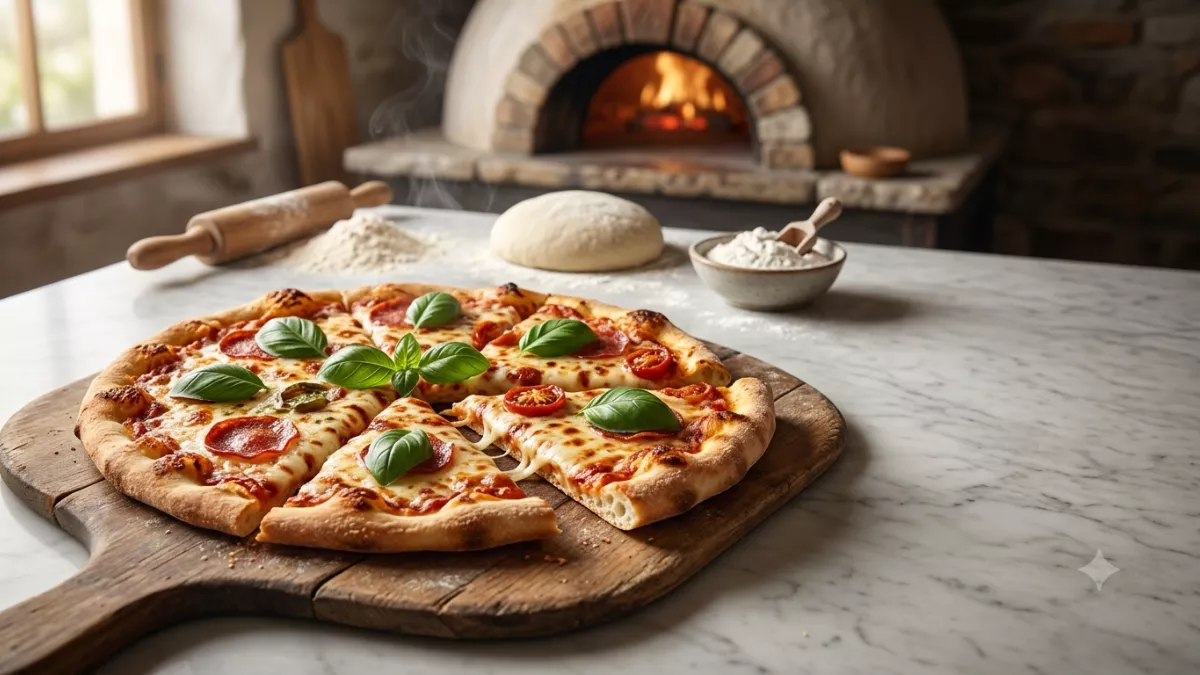
There is something incredibly satisfying about biting into a pizza with a perfectly crispy crust. The bottom has a light crunch, the edges are beautifully browned, and the inside still has enough softness and chew to make every bite enjoyable.
Unfortunately, homemade pizza doesn’t always turn out that way.
Sometimes the crust is too soft. Sometimes the center becomes soggy. Other times, the outside gets brown while the middle remains undercooked.
The good news is that crispy pizza crust isn’t difficult to achieve once you understand the factors that affect it.
From the flour and dough hydration to fermentation, oven temperature, baking surface, and toppings, every stage of pizza preparation can influence the final texture.
In this guide, we’ll reveal 7 practical secrets for making the perfect crispy pizza crust at home and explain exactly how each one can improve your pizza.
What Makes a Pizza Crust Crispy?
A crispy pizza crust develops when the dough loses enough moisture during baking while the exterior receives sufficient heat to brown and firm up.
Several factors influence this process:
- Dough thickness
- Hydration
- Flour selection
- Fermentation
- Oven temperature
- Baking surface
- Topping moisture
- Baking time
- Air circulation
A thin dough generally becomes crisp more easily than a thick one, but thinness alone isn’t enough.
If the dough contains too much moisture or is covered with wet toppings, the center can remain soft even when the edges are nicely browned.
The goal is to create a crust that is crisp on the outside while maintaining a pleasant texture inside.
Secret 1: Choose the Right Flour
The flour you use has a major influence on your pizza dough.
Bread flour is a popular choice for homemade pizza because its relatively high protein content can help create a strong gluten network.
A stronger gluten structure allows the dough to stretch while maintaining enough structure during baking.
Pizza-specific flours can also work very well, particularly when you’re following a recipe designed around their characteristics.
What should you look for?
When selecting flour, consider:
- Protein content
- Intended use
- Dough hydration
- Fermentation time
- Pizza style
For a crispy homemade pizza, don’t assume that adding more flour is the solution.
Too much flour during mixing or shaping can make the crust dense and dry rather than pleasantly crisp.
The objective is to create a dough that is structured enough to hold its shape but still has enough moisture to develop a good interior texture.
Secret 2: Get Your Dough Hydration Right
Hydration refers to the amount of water in the dough relative to the flour.
A dough with more water generally produces a different crumb and texture from a lower-hydration dough.
For a particularly crisp pizza, a moderate or somewhat lower hydration can be easier to manage in a home oven.
However, the ideal hydration depends on the pizza style and flour.
If the dough is extremely wet, it can be difficult to handle and may require more baking to remove enough moisture.
If it is excessively dry, the finished crust can become hard rather than pleasantly crispy.
The key is balance
You want enough water for:
- Gluten development
- Fermentation
- Tenderness
- Stretchability
But you also want the finished crust to be able to lose moisture efficiently during baking.
When making pizza at home, follow your recipe’s flour-to-water ratio rather than adding large amounts of flour simply because the dough feels sticky.
Secret 3: Give the Dough Enough Time to Ferment
If you want better pizza, don’t rush the dough.
Fermentation allows yeast and other processes to develop flavor and change the dough’s structure.
A short fermentation can produce good pizza, but a longer fermentation often gives you more flexibility and a more developed flavor.
One popular approach is refrigerated fermentation.
After preparing the dough, place it in a covered container in the refrigerator for approximately 24 to 72 hours.
Before baking, allow the dough to warm and relax enough to stretch easily.
Why fermentation helps
Proper fermentation can improve:
- Flavor
- Dough extensibility
- Texture
- Crust structure
- Browning
A well-fermented dough is often easier to shape and can produce a more interesting crust than dough that has been mixed and immediately baked.
If you only have a few hours, don’t worry. A same-day dough can still produce excellent pizza.
Secret 4: Preheat Your Oven as Hot as Safely Possible
This is one of the most important secrets to crispy homemade pizza.
Professional pizza ovens operate at very high temperatures, allowing pizza to cook rapidly.
Most home ovens cannot reach the same temperatures, but you can still maximize your results by thoroughly preheating your oven.
Set the oven to its highest appropriate temperature according to the manufacturer’s instructions.
Don’t rush the preheating process.
If you’re using a pizza stone or baking steel, it needs time to become fully heated.
Why high heat matters
Strong heat helps:
- Crisp the bottom of the dough
- Brown the crust
- Melt the cheese quickly
- Cook toppings efficiently
- Reduce the amount of time moisture remains in the dough
A low-temperature oven can leave pizza sitting in the oven for a long time, increasing the chance that the toppings overcook before the crust reaches the desired texture.
Secret 5: Use a Pizza Stone or Baking Steel
A pizza stone or baking steel can make a major difference in homemade pizza.
Both are designed to provide a hot cooking surface that transfers heat directly into the bottom of the dough.
Pizza stone
A pizza stone stores heat and releases it into the dough during baking.
This can help produce a crisp bottom.
Baking steel
A baking steel conducts heat very efficiently and can provide strong heat transfer to the pizza base.
Both options can work well.
If you don’t own either, a heavy metal baking sheet can still produce good results when thoroughly preheated.
How to use one
Place your stone or steel in the oven before preheating.
Give it enough time to become thoroughly heated.
Then transfer your prepared pizza onto the hot surface.
Be careful when handling heated equipment, and follow the manufacturer’s instructions for your specific stone or steel.
Secret 6: Control Moisture From Sauce and Toppings
Even a perfectly prepared dough can become soggy if you cover it with too much moisture.
This is one of the most common reasons homemade pizza doesn’t develop a crisp center.
Several common pizza ingredients contain significant moisture.
These include:
- Fresh tomatoes
- Mushrooms
- Pineapple
- Fresh mozzarella
- Spinach
- Certain sauces
- Vegetables
This doesn’t mean you need to avoid these ingredients.
Instead, prepare them properly.
Drain wet ingredients
If you’re using canned pineapple, drain it thoroughly.
If you’re using fresh mozzarella, consider draining or patting it dry before placing it on the pizza.
Pre-cook mushrooms
Mushrooms release water during cooking.
Briefly sautéing them can remove some moisture before they go onto the pizza.
Use a thin layer of sauce
Spread the sauce evenly but avoid creating a thick pool in the center.
Don’t overload the pizza
A heavily topped pizza takes longer to cook and can trap moisture.
For a crispy crust, restraint is often your friend.
Secret 7: Stretch the Dough Thin and Bake It Correctly
The final secret combines shaping and baking technique.
If you want a crisp pizza, the center should generally be thinner than a thick pan-style crust.
Gently stretch the dough to your desired size.
Avoid flattening the entire outer edge if you want a more pronounced crust border.
Don’t make the center too thick
A thick center contains more moisture and takes longer to bake.
A thinner center allows heat to reach the dough more efficiently.
Don’t make it paper-thin
There is also a limit.
An extremely thin dough can become hard and brittle instead of crisp and enjoyable.
Aim for the texture appropriate to your chosen pizza style.
The Best Baking Position for Crispy Pizza
Where you position your pizza in the oven can affect the result.
For stronger bottom browning, a preheated stone or steel positioned appropriately in the oven can help.
For more top browning, moving the pizza higher or using the broiler briefly near the end can sometimes help.
However, every oven behaves differently.
Experiment with your oven and pay attention to:
- Bottom color
- Edge browning
- Cheese bubbling
- Overall cooking time
Your goal is a crust that is cooked through and browned without burning the toppings.
How to Prevent a Soggy Pizza Center
If your pizza has crispy edges but a soft center, don’t immediately blame the dough.
Several things could be happening.
Problem: Too much sauce
Solution: Use a thinner layer.
Problem: Too many toppings
Solution: Reduce the quantity and distribute them evenly.
Problem: Wet vegetables
Solution: Drain, dry, or pre-cook them.
Problem: Low oven temperature
Solution: Preheat more thoroughly and use the highest appropriate setting.
Problem: Cold baking surface
Solution: Preheat your stone, steel, or baking tray before baking.
Problem: Pizza is too thick
Solution: Stretch the center thinner.
How to Make Pizza Crust Crispy Without a Pizza Stone
You can still make crispy pizza without specialized equipment.
Use a heavy metal baking sheet.
Place the baking sheet upside down if its shape allows, and preheat it in the oven.
Once the oven and baking surface are hot, carefully transfer the prepared pizza onto the tray.
The hot metal will provide stronger initial heat to the dough than a cold tray.
A cast-iron pan can also be useful for certain pizza styles, although it produces a different crust from a classic thin-crust pizza.
Crispy Pizza Crust vs. Chewy Pizza Crust
Crispy and chewy aren’t necessarily opposites.
A well-made pizza can have both.
You might get:
Crispy bottom + chewy interior + airy edge
This combination is one of the reasons pizza texture can be so enjoyable.
The precise balance depends on:
- Flour
- Hydration
- Fermentation
- Dough thickness
- Oven temperature
- Baking time
- Baking surface
If you prefer an especially crisp pizza, experiment with a thinner dough and strong bottom heat.
If you prefer more chew, keep more thickness in the crust and use a dough formula designed for that style.
5 Easy Topping Combinations for Crispy Pizza
A crisp crust pairs particularly well with toppings that don’t introduce excessive moisture.
1. Classic Pepperoni
Tomato sauce + mozzarella + pepperoni
A simple combination that allows the crust to remain the star.
2. Mushroom and Onion
Mozzarella + mushrooms + onions + tomato sauce
For extra crispness, pre-cook the mushrooms.
3. Sausage and Peppers
Italian sausage + bell peppers + onions + mozzarella
A flavorful combination that works especially well on a thin crust.
4. Margherita-Style
Tomato + mozzarella + basil + olive oil
Use moderate amounts of fresh tomato and mozzarella to help control moisture.
5. Bacon and Jalapeño
Mozzarella + cooked bacon + jalapeños + tomato sauce
The salty bacon and spicy peppers provide plenty of flavor without requiring a large number of toppings.
A Simple Crispy Pizza Dough Formula
For a straightforward homemade pizza, try this basic approach.
Ingredients
- 3 cups bread flour
- 1 cup plus 2 tablespoons water
- 1 teaspoon instant yeast
- 1 teaspoon salt
- 1 tablespoon olive oil
Method
- Combine the flour and yeast.
- Gradually add the water.
- Mix until a rough dough forms.
- Add salt and olive oil.
- Knead until the dough becomes smooth and elastic.
- Cover and allow it to rise.
- For additional flavor, refrigerate the dough for 24 to 72 hours.
- Bring the dough toward room temperature before shaping.
- Stretch it into a thin pizza base.
- Add a moderate amount of sauce, cheese, and toppings.
- Bake on a thoroughly preheated surface at the highest appropriate oven temperature.
- Remove when the crust is browned and crisp.
Because flour absorbs water differently, you may need to make small adjustments to the dough consistency.
Common Mistakes to Avoid
Adding too much flour
Extra flour can make the crust tough.
Using too many toppings
A heavy topping load adds moisture and weight.
Skipping preheating
A cold oven or cold baking surface can make it much harder to achieve a crisp bottom.
Using excessive sauce
A thick layer of sauce can make the center soggy.
Opening the oven repeatedly
Every time you open the oven, heat escapes.
Try to keep the door closed as much as possible while the pizza cooks.
Cutting the pizza immediately
Let the pizza rest briefly before slicing. This gives the cheese and toppings a moment to settle.
Frequently Asked Questions
How do I make my pizza crust crispy?
Use a suitable flour, control dough hydration, ferment the dough properly, stretch it relatively thin, minimize wet toppings, and bake it on a thoroughly preheated surface at a high temperature.
Why is my pizza crust not crispy?
Common causes include excessive moisture, a thick dough, insufficient oven temperature, a cold baking surface, or too many toppings.
Does olive oil make pizza crust crispy?
A small amount of olive oil can influence the dough’s texture and browning, but crispness depends on several factors, including hydration, oven temperature, dough thickness, and baking surface.
Is a pizza stone better than a baking sheet?
A properly preheated pizza stone can provide strong heat transfer to the dough. A heavy baking sheet can also work, especially when thoroughly preheated. Baking steel is another option that provides efficient heat transfer.
Can I make crispy pizza in a regular oven?
Yes. Preheat the oven thoroughly, use its highest appropriate temperature, keep toppings moderate, and use a preheated stone, steel, or heavy baking sheet if available.
Final Thoughts
Making the perfect crispy pizza crust at home is a combination of preparation, heat, moisture control, and practice.
The seven most important secrets are:
- Choose the right flour.
- Control dough hydration.
- Give the dough enough time to ferment.
- Preheat your oven thoroughly and use strong heat.
- Use a pizza stone, steel, or preheated heavy baking surface.
- Control moisture from sauce and toppings.
- Stretch the dough appropriately and bake it correctly.
You don’t need expensive restaurant equipment to start improving your pizza.
Focus on the fundamentals first. Make your dough consistently, experiment with fermentation times, preheat your oven properly, and pay attention to moisture.
After a few attempts, you’ll begin to understand exactly how your oven and dough behave.
And once you achieve that satisfying combination of a crisp bottom, golden edges, and tender interior, homemade pizza can become just as exciting as ordering from your favorite pizzeria.