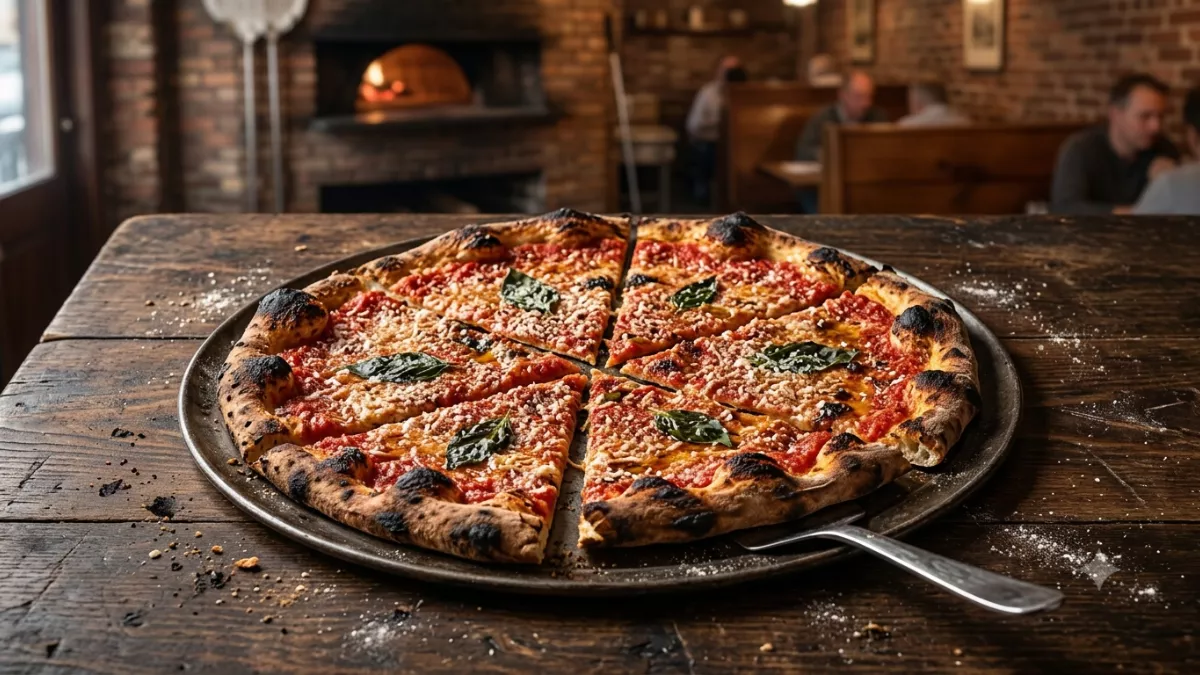
Pizza comes in countless regional varieties, from the large, foldable slices of New York to the thick, layered pies associated with Chicago. However, one of the most distinctive American pizza traditions comes from New Haven, Connecticut. Known locally as apizza, this style has earned a loyal following for its thin crust, intense oven-baked flavor, and characteristic charred spots.
New Haven Apizza is more than a regional variation of an everyday favorite. It reflects generations of Italian-American cooking, neighborhood traditions, and a particular approach to dough, toppings, and high-temperature baking. Its appearance may surprise people who expect a uniformly golden crust or generous layers of cheese. Instead, apizza celebrates a crisp, chewy base with darkened edges and carefully balanced ingredients.
Whether topped with tomato sauce and mozzarella or prepared with the famous combination of tomato, garlic, oregano, and grated cheese, New Haven Apizza offers a memorable experience. Understanding its origins, preparation, and defining characteristics helps explain why this Connecticut specialty has become one of America’s most respected pizza styles.
What Is New Haven Apizza?
New Haven Apizza is a regional pizza style that originated in New Haven, Connecticut, within the city’s Italian-American community. The word apizza is commonly pronounced “ah-BEETZ,” reflecting the influence of the Neapolitan dialect brought to the United States by Italian immigrants.
The style is closely associated with thin, irregularly shaped dough, a chewy interior, and a crust that develops dark charred spots during baking. Unlike some American pizza varieties that emphasize thick dough or abundant toppings, New Haven Apizza focuses on the relationship between the crust, tomato, cheese, and oven heat.
Traditional examples are often baked in coal-fired ovens, which can reach temperatures that produce a distinctive combination of crispness, chewiness, and smoky, roasted flavors. The surface may look uneven or heavily browned, but the dark spots are part of the style’s identity when they result from controlled high-temperature baking.
New Haven Apizza is commonly served as a whole pie rather than as oversized individual slices. Its toppings are generally applied with restraint, allowing the dough and tomato to remain prominent.
The style is not limited to one specific topping combination. Some versions include mozzarella, while others emphasize tomato, garlic, oregano, olive oil, and grated hard cheese. These variations demonstrate that New Haven Apizza is defined as much by its cooking method and crust as by any single recipe.
The History of New Haven Apizza
The story of New Haven Apizza is closely connected to Italian immigration and the development of Italian-American neighborhoods in Connecticut during the late nineteenth and early twentieth centuries.
Italian immigrants brought culinary traditions, food preferences, and baking techniques from their home regions. As communities established themselves in New Haven, local businesses adapted familiar foods to available ingredients, customer preferences, and the practical demands of neighborhood dining.
Frank Pepe Pizzeria Napoletana, established in New Haven in 1925, became one of the most influential names in this tradition. Pepe’s helped establish the city’s reputation for thin-crust pizza baked at high temperatures, and its approach became a reference point for generations of pizza makers.
Other long-standing establishments, including Sally’s Apizza and Modern Apizza, also helped shape the city’s distinctive pizza culture. Each developed its own identity through crust preparation, sauce, cheese, oven technique, and signature combinations.
Over time, the word apizza became closely associated with New Haven’s local food identity. What began as a neighborhood tradition attracted attention from food writers, travelers, and pizza enthusiasts throughout the United States.
Today, New Haven Apizza is recognized as an important regional American food tradition. Its continued popularity reflects both the consistency of established pizzerias and the broader interest in foods with a strong sense of place.
Why Is It Called Apizza?
The term apizza is a distinctive part of New Haven’s culinary identity. It is generally understood to reflect the pronunciation of pizza in the Neapolitan dialect spoken by some Italian immigrants who settled in the area.
In standard American English, pizza is usually pronounced “PEET-suh.” The local pronunciation associated with apizza sounds closer to “ah-BEETZ.” Although the exact pronunciation can vary, the term has endured as a recognizable marker of the city’s pizza tradition.
The name also illustrates how immigrant communities preserve elements of their original languages through everyday food culture. Words associated with familiar meals can survive for generations, even as the dishes themselves adapt to a new environment.
In New Haven, apizza is not simply an alternative spelling. It signals a local tradition shaped by family businesses, regional tastes, and a particular approach to baking.
Visitors may see both “pizza” and “apizza” used in restaurant names and menus. However, the term apizza is especially associated with the classic New Haven style.
The Distinctive Crust: Thin, Chewy, and Charred
The crust is arguably the most recognizable feature of New Haven Apizza. It is generally thin, with an uneven outline and a texture that combines a crisp exterior with a chewy center.
Unlike pizza styles that aim for a uniformly golden surface, New Haven Apizza often displays pronounced dark spots across the rim and underside. These marks develop through intense heat and contact with the oven’s hot cooking surface.
The result depends on several factors, including flour selection, dough hydration, fermentation, shaping technique, and baking temperature. Dough that has fermented properly can develop greater flavor and a more appealing texture. Skilled shaping helps preserve air within the edge while keeping the center relatively thin.
Coal-fired ovens are historically associated with the style. They provide intense heat and help create the roasted character that many fans expect. Nevertheless, oven type alone does not guarantee authentic results; the baker must also manage the dough, toppings, and baking time carefully.
The dark crust is not intended to taste uniformly burnt. Rather, the contrast between browned areas and lighter sections contributes to a complex flavor. When properly prepared, the crust should retain a pleasant chew and a savory, toasted character.
For first-time diners, the appearance can be surprising. Yet once tasted, the combination of crispness, chewiness, and char helps explain why the crust has become a defining characteristic of New Haven Apizza.
Coal-Fired Baking and Its Role in Flavor
Coal-fired ovens are an important part of New Haven’s pizza history. They can generate intense heat, allowing a thin pizza to cook quickly while developing deep browning and characteristic char.
The cooking environment affects both texture and flavor. High temperatures encourage the surface to brown while the dough’s interior remains tender. They also influence how tomato sauce, cheese, and other toppings cook together.
Coal-fired baking is often associated with a distinctive roasted flavor. However, it is important not to assume that every dark spot comes from smoke or that every coal-fired pizza tastes the same. Dough composition, oven design, heat distribution, and the baker’s technique all contribute to the finished product.
Traditional coal ovens also require careful management. Their heat can be less forgiving than a lower-temperature cooking environment, especially when the pizza is thin and the toppings are relatively light. Too little heat may produce a pale, soft crust, while excessive exposure can lead to unpleasant bitterness.
Some modern pizzerias use other types of ovens while attempting to reproduce aspects of the New Haven style. Although the results may differ, a carefully prepared dough and high-temperature baking can still create a satisfying combination of crispness and chew.
The appeal of New Haven Apizza lies not only in the oven itself but also in how the entire baking process is managed.
Traditional Toppings and Signature Flavor Combinations
New Haven Apizza is known for toppings that complement rather than conceal the crust. Tomato sauce is a central ingredient, often providing a bright, savory foundation. Cheese may be added generously or sparingly, depending on the style of pie.
Several combinations are particularly associated with New Haven.
Tomato pie: A traditional choice featuring tomato sauce, olive oil, garlic, oregano, and sometimes grated hard cheese. It is often prepared without mozzarella, allowing the tomato and crust to take center stage.
Mozzarella pizza: A familiar option with tomato sauce and melted mozzarella. The cheese adds richness and softness, creating a contrast with the crisp, charred crust.
White clam pizza: One of New Haven’s most famous specialties, commonly associated with Frank Pepe’s. It combines clams with ingredients such as garlic, olive oil, and grated cheese, often without a conventional tomato sauce. Exact preparations vary by restaurant.
Sausage pizza: A popular variation that adds savory sausage to the traditional base. The meat contributes richness and a stronger seasoning profile.
Vegetable-topped pizza: Some versions feature ingredients such as onions, peppers, mushrooms, or other vegetables. The best results generally depend on controlling moisture so that the thin crust remains well baked.
These toppings show the range of New Haven Apizza while preserving its emphasis on a thin base and a strongly baked crust. Individual pizzerias often have signature recipes, so diners may find meaningful differences between establishments.
What Makes New Haven Apizza Different From New York Pizza?
New Haven Apizza and New York-style pizza share historical connections to Italian-American cooking. Both commonly use a relatively thin crust and tomato-based toppings, but their texture, shape, and serving traditions differ.
| Feature | New Haven Apizza | New York-Style Pizza |
|---|---|---|
| Crust | Thin, chewy, often noticeably charred | Thin, flexible, often crisp underneath |
| Shape | Frequently irregular or rustic | Usually round and more uniform |
| Baking tradition | Strongly associated with coal-fired ovens | Traditionally associated with gas deck ovens in many pizzerias |
| Texture | Crisp and chewy, with darkened spots | Foldable, with a balance of crispness and flexibility |
| Toppings | Often applied with restraint | Can range from simple to generously topped |
| Serving style | Commonly sold as a whole pie | Often available by the slice or as a whole pie |
| Signature reputation | Charred crust and distinctive local traditions | Large, foldable slices and a broad range of toppings |
These are general distinctions rather than strict rules. Modern pizzerias frequently combine techniques, and individual recipes vary. Still, the comparison highlights why New Haven Apizza is considered its own regional style rather than simply another version of New York pizza.
New Haven Apizza Compared With Neapolitan Pizza
Neapolitan pizza is an important historical reference for understanding New Haven Apizza. Both traditions are linked to Italian pizza-making, relatively simple toppings, and a crust whose texture plays a central role in the eating experience.
Traditional Neapolitan pizza typically has a soft, tender center and a puffy rim. It is often baked in a very hot wood-fired oven, producing rapid cooking and characteristic spotting on the crust.
New Haven Apizza generally has a thinner profile and is particularly known for its more pronounced char. Its long development within Italian-American communities means that it reflects local adaptation rather than a direct reproduction of every Neapolitan technique.
The differences can also be seen in how the pizzas are perceived. Neapolitan pizza is often associated with softness, lightness, and a delicate balance of toppings. New Haven Apizza is widely celebrated for its chewy crust, robust baked flavor, and darkened edges.
Neither style is inherently better. The preference depends on whether someone enjoys a softer, more delicate pizza or a thinner, more deeply browned one.
How New Haven Apizza Is Made
Preparing New Haven-style pizza involves several steps, beginning with dough and ending with high-temperature baking.
1. Preparing the dough
The dough is made from basic ingredients such as flour, water, salt, and yeast. The proportions affect elasticity, hydration, and the final texture. A period of fermentation allows the dough to develop flavor and structure.
2. Fermenting the dough
Fermentation is an important part of producing a flavorful crust. Time and temperature must be managed carefully, as overproofed or underproofed dough can be difficult to shape and bake consistently.
3. Shaping the base
The dough is stretched into a thin round or slightly irregular shape. Careful handling helps preserve some air in the outer edge while keeping the center relatively thin.
4. Adding toppings
Tomato sauce is spread across the base, followed by cheese or other ingredients according to the chosen recipe. Toppings are generally balanced to prevent the center from becoming excessively wet.
5. Baking at high heat
The pizza is baked in a very hot oven until the dough cooks through and develops the desired browning and char. The precise baking time depends on oven temperature, dough thickness, and toppings.
6. Serving fresh
New Haven Apizza is best enjoyed soon after baking, when its contrast of crispness, chewiness, and tender toppings is most noticeable.
Home cooks can adapt the method using a well-preheated oven and a pizza stone or steel. However, domestic ovens usually operate at lower temperatures than traditional coal-fired pizza ovens, so the crust may not develop exactly the same texture or char.
Is New Haven Apizza Supposed to Be Burnt?
This is one of the most common questions people ask when encountering New Haven Apizza for the first time.
The short answer is that char is a recognized feature of the style, but the goal is not to burn the entire pizza. Darkened spots create a roasted flavor and contrast with the softer parts of the crust.
Properly baked apizza should still taste balanced. If the crust is overwhelmingly bitter, the toppings are dried out, or the dough has become unpleasantly hard, the pizza may have been overbaked.
The difference lies in controlled browning. Experienced pizza makers understand how the dough responds to heat and how to position or rotate the pie when necessary.
People who prefer a uniformly pale, soft crust may find New Haven Apizza too charred at first. Others enjoy the contrast because it adds depth and makes the crust a more prominent part of the meal.
Ultimately, the best example combines darkened spots with a cooked, flavorful interior and toppings that remain enjoyable.
Where Did the Famous White Clam Pizza Come From?
White clam pizza is one of the best-known specialties associated with New Haven. It is particularly connected to Frank Pepe Pizzeria Napoletana and has become a major reason food enthusiasts visit the city.
Unlike a conventional tomato pizza, white clam pizza is typically built around clams, garlic, olive oil, and grated cheese. Some versions include additional seasonings, and recipes can differ between restaurants.
The combination reflects the way regional food traditions develop. Italian-American pizza makers adapted their familiar dough and baking methods to ingredients available in the surrounding area. Seafood became a distinctive topping, producing a pizza that differed from the more widely recognized tomato-and-mozzarella combination.
The flavor is savory and briny, with garlic and oil supporting the natural character of the clams. The high-temperature oven helps cook the topping while developing the characteristic crust.
White clam pizza may not appeal to everyone, particularly those who prefer traditional cheese pizza. However, it illustrates the creativity within New Haven’s pizza culture and demonstrates that the style extends beyond a single crust recipe.
Anyone interested in exploring the city’s food traditions may find it worthwhile to compare a classic tomato pie with a white clam pizza.
How to Eat and Enjoy New Haven Apizza
There is no complicated ritual required to enjoy New Haven Apizza. However, a few simple choices can make the experience more rewarding.
First, consider starting with a classic tomato pie or a mozzarella pizza. These options make it easier to appreciate the crust without having a large number of toppings competing for attention.
Next, pay attention to the texture. Notice the contrast between the crisp outer areas, chewy interior, and any darkened spots. The crust is a major part of the style, not merely a container for the toppings.
If dining with friends, ordering different varieties can make the meal more interesting. A tomato pie, a mozzarella pizza, and a white clam pizza provide contrasting flavors while showcasing different approaches to the same basic dough.
Freshly baked pizza is generally the best choice. As it cools, moisture from the toppings can change the texture of the crust. Leftovers can still be enjoyable when reheated appropriately, but they may not reproduce the original crispness.
Finally, avoid judging the style by appearance alone. The dark crust may look unusual, but the real measure is whether the char, dough, sauce, and toppings work together in a balanced way.
Why New Haven Apizza Remains Popular
New Haven Apizza has endured because it offers something distinctive without abandoning the fundamentals of good pizza. Its crust has a recognizable texture, its traditional toppings emphasize ingredient quality, and its best-known restaurants have built reputations over generations.
The style also benefits from a strong connection to place. People associate it with New Haven’s Italian-American heritage, established neighborhood pizzerias, and local pride. Visiting a well-known apizza restaurant can feel like participating in a food tradition rather than simply ordering a meal.
At the same time, the style appeals to modern diners who are interested in regional foods and traditional baking methods. Its emphasis on carefully prepared dough and restrained toppings contrasts with pizza varieties that rely on large quantities of cheese or numerous ingredients.
The city’s signature pies have also helped broaden the public understanding of American pizza. They demonstrate that the country does not have one single pizza tradition but many regional styles shaped by immigration, local ingredients, and individual craftsmanship.
As interest in regional food continues, New Haven Apizza remains an important example of how a local specialty can gain national recognition while retaining its identity.
Frequently Asked Questions
1. What does apizza mean?
Apizza is the local term associated with New Haven’s distinctive pizza tradition. It is commonly pronounced “ah-BEETZ” and reflects the influence of the Neapolitan dialect spoken by some Italian immigrants.
2. What makes New Haven Apizza unique?
Its most recognizable characteristics are a thin, chewy crust, pronounced charred spots, carefully balanced toppings, and a strong historical connection to New Haven, Connecticut. Traditional coal-fired baking is also closely associated with the style.
3. Is New Haven Apizza always made without mozzarella?
No. Some traditional varieties, such as tomato pie, may be prepared without mozzarella, while other versions include melted mozzarella. The choice depends on the recipe and the pizzeria.
4. What is white clam pizza?
White clam pizza is a New Haven specialty commonly made with clams, garlic, olive oil, and grated cheese, often without tomato sauce. It is particularly associated with Frank Pepe Pizzeria Napoletana.
5. Can I make New Haven Apizza at home?
Yes. You can prepare a similar style using fermented dough, restrained toppings, and a thoroughly preheated oven with a pizza stone or steel. A standard home oven may not reproduce the exact char and texture of a traditional coal-fired oven.
Last Thought
New Haven Apizza is a distinctive part of Connecticut’s food heritage and one of America’s most recognizable regional pizza styles. Its thin, chewy crust, characteristic char, and balanced toppings create an experience that differs from New York and Neapolitan pizza. From classic tomato pie to the celebrated white clam variety, the style reflects generations of Italian-American cooking and the creativity of local pizza makers. Its appeal comes from treating every element as important, from fermentation and oven temperature to sauce and toppings. For anyone interested in regional American cuisine, New Haven Apizza offers a delicious example of how tradition, technique, and local identity can turn a simple dish into a lasting culinary classic.