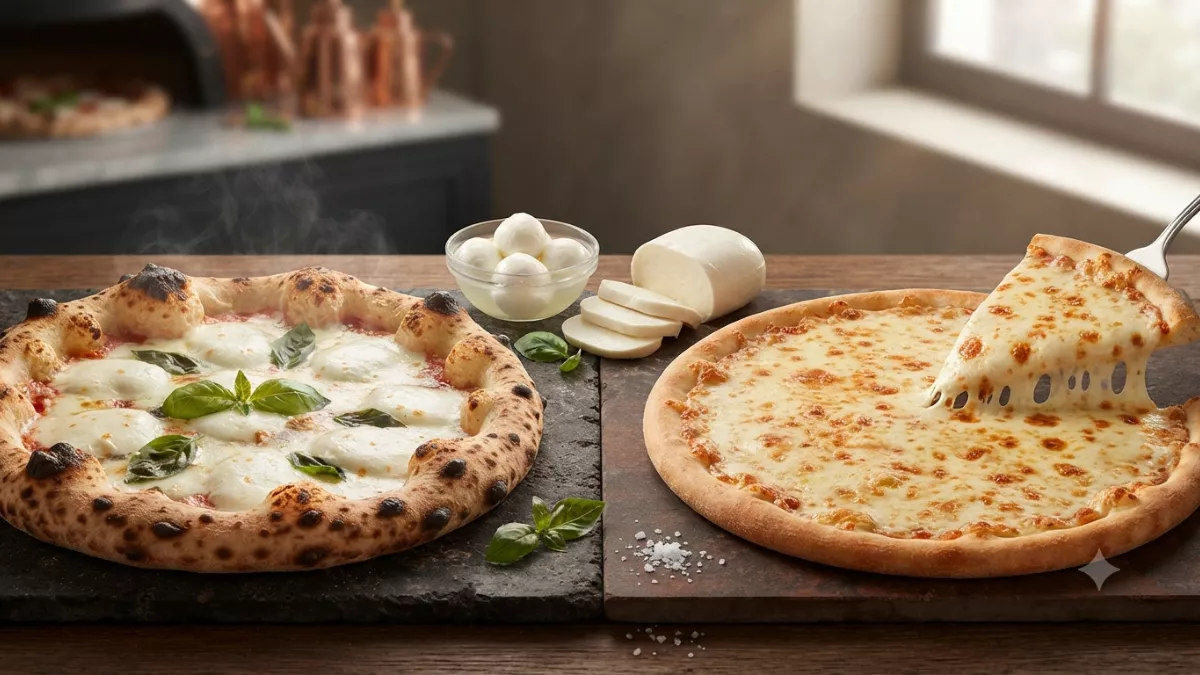
Mozzarella is one of the defining ingredients of pizza. Its creamy texture, mild flavor, stretch, and ability to melt beautifully make it a natural partner for tomato sauce and pizza dough. But not all mozzarella behaves the same way in the oven.
One of the most common choices pizza makers face is fresh mozzarella vs. low-moisture mozzarella.
Fresh mozzarella is soft, milky, delicate, and relatively high in moisture. Low-moisture mozzarella is firmer, easier to shred, and contains less water. Both can produce delicious pizza, but they behave differently during baking.
So which one works better on pizza?
The answer depends on the pizza style, oven temperature, desired texture, cooking time, and personal preference. Fresh mozzarella can provide a soft, creamy bite and a delicate milky flavor, while low-moisture mozzarella generally offers predictable melting, stronger browning, and easier moisture control.
In this guide, we’ll compare fresh mozzarella and low-moisture mozzarella, explain how each behaves in the oven, and help you understand which option may work best for different types of pizza.
What Is Fresh Mozzarella?
Fresh mozzarella is a soft cheese traditionally made using a pasta filata, or stretched-curd, process.
It is usually sold in forms such as balls, ovals, or small pieces and is often stored in water, whey, or another liquid.
Fresh mozzarella has a soft texture and relatively high moisture content.
Its flavor is generally mild, milky, and slightly tangy.
Because of its moisture, fresh mozzarella behaves differently from the firmer mozzarella commonly sold in blocks or shredded bags.
When heated, fresh mozzarella softens quickly and releases some moisture.
This can create a beautifully creamy topping, but too much moisture can make the surface of a pizza wetter than desired.
What Is Low-Moisture Mozzarella?
Low-moisture mozzarella is made using a similar general cheese-making tradition but is processed to remove more moisture.
The result is a firmer cheese that can be sold in blocks, logs, slices, or pre-shredded forms.
Low-moisture mozzarella is particularly common in American-style pizza because it melts consistently and provides good coverage.
Compared with fresh mozzarella, it generally has:
- Less water
- A firmer texture
- Easier shredding
- Longer storage life
- More predictable melting
- Greater browning potential
These characteristics make it convenient for many pizza applications.
Fresh Mozzarella vs. Low-Moisture Mozzarella at a Glance
The two cheeses have several important differences.
Fresh mozzarella:
- High moisture
- Soft and delicate
- Mild milky flavor
- Creamy texture
- Often sold in liquid
- Can release significant moisture
- Works particularly well with certain high-heat pizza styles
Low-moisture mozzarella:
- Lower moisture
- Firmer texture
- Easy to shred
- Reliable melting
- Better suited to longer baking
- Can develop attractive browning
- Commonly used for American-style pizza
Neither cheese is universally better.
They simply produce different results.
1. Moisture Content Is the Biggest Difference
The most important distinction is moisture.
Fresh mozzarella contains substantially more water than low-moisture mozzarella.
That water affects what happens when the cheese enters a hot oven.
As the pizza bakes, the moisture inside fresh mozzarella heats up and can escape as steam.
This can create small pools of liquid on the pizza.
That’s not necessarily a problem.
In the right pizza style, that moisture can contribute to a juicy, creamy bite.
But if the pizza already contains a wet sauce or moisture-rich toppings, additional water from the cheese can make the center difficult to crisp.
Low-moisture mozzarella contains less water, so it generally releases less moisture during baking.
This can make it easier to achieve a drier, more evenly melted cheese layer.
2. How Fresh Mozzarella Melts
Fresh mozzarella doesn’t behave exactly like shredded low-moisture mozzarella.
Instead of instantly creating a completely uniform layer, fresh mozzarella tends to soften into distinct melted patches.
As it heats, individual pieces spread and become glossy.
This can create a visually appealing artisan-style pizza.
The result is often creamy rather than heavily browned.
If you prefer visible areas of cheese rather than a perfectly uniform blanket, fresh mozzarella can be a great choice.
Fresh mozzarella can create a luxurious texture
Because of its moisture and soft structure, fresh mozzarella can create a tender, creamy mouthfeel.
It works especially well when paired with simple ingredients.
Tomato sauce, basil, olive oil, and fresh mozzarella can create a pizza where every ingredient remains recognizable.
3. How Low-Moisture Mozzarella Melts
Low-moisture mozzarella is particularly popular because of its predictable melting behavior.
When shredded and distributed evenly, it can melt into a relatively uniform layer.
It can also develop small browned areas when exposed to sufficient heat.
That combination makes it particularly useful for pizzas where you want:
- Even cheese coverage
- Reliable melting
- Good browning
- Consistent texture
- Strong cheese pull
This is one reason low-moisture mozzarella is widely used in American pizza kitchens.
4. Which Cheese Gets More Crispy and Brown?
If your goal is a deeply browned cheese surface, low-moisture mozzarella is often easier to work with.
Its lower moisture content allows the surface to reach browning temperatures more readily.
Fresh mozzarella contains more water, which can keep its temperature lower while that moisture is evaporating.
That means it may melt beautifully without becoming heavily browned.
However, oven temperature and baking time still matter enormously.
A very hot oven can brown fresh mozzarella quickly once enough surface moisture has evaporated.
So cheese type isn’t the only factor.
5. Which Has Better Flavor?
Flavor is subjective, but the two cheeses have noticeable differences.
Fresh mozzarella typically has a delicate, milky flavor.
Because it contains more moisture and is often consumed relatively fresh, its flavor can feel clean and subtle.
Low-moisture mozzarella generally has a more concentrated dairy flavor.
Depending on the specific cheese, it may also have more saltiness and a slightly firmer, more pronounced character.
On pizza, these differences become part of the overall flavor balance.
Fresh mozzarella can allow tomato sauce and herbs to remain prominent.
Low-moisture mozzarella can provide a stronger, richer cheese presence.
6. Which Is Better for New York-Style Pizza?
New York-style pizza can be made with different mozzarella formulations, and practices vary among pizzerias.
Low-moisture mozzarella is often a practical choice because New York-style pizza typically needs to withstand a relatively substantial bake while maintaining a sliceable structure.
The cheese melts evenly and can brown without releasing as much water as fresh mozzarella.
However, fresh mozzarella can also be used successfully, especially when the pizza is designed around its texture and moisture.
If using fresh mozzarella on a thinner pizza, draining it thoroughly is particularly important.
7. Which Is Better for Neapolitan-Style Pizza?
Fresh mozzarella is strongly associated with traditional Italian pizza styles.
A high-temperature, fast bake works particularly well with fresh cheese because the pizza spends relatively little time in the oven.
The cheese can soften and melt without having enough time to completely dry out.
This creates the characteristic combination of soft crust, tomato, creamy cheese, and fresh herbs.
For a traditional-style pizza with a short, very hot bake, fresh mozzarella can be a natural choice.
8. Which Is Better for Homemade Pizza?
For home cooks, low-moisture mozzarella is often easier to manage.
A typical home oven doesn’t reach the same temperatures as many professional pizza ovens.
That means pizza may spend more time baking.
Fresh mozzarella can release more water during a longer bake.
If you are using a standard home oven and want a predictable result, low-moisture mozzarella can therefore be more forgiving.
That doesn’t mean you should avoid fresh mozzarella.
It simply means you may need to prepare it properly.
How to Prepare Fresh Mozzarella for Pizza
One of the biggest mistakes when using fresh mozzarella is placing very wet pieces directly onto the pizza.
Instead, drain the cheese first.
Step 1: Remove it from the liquid
Take the mozzarella out of its packaging and allow excess liquid to drain.
Step 2: Slice or tear it
Cut the cheese into relatively small pieces or tear it into manageable chunks.
Step 3: Drain again
Place the pieces on a clean paper towel or another suitable surface.
Allow additional moisture to drain away.
Step 4: Use moderate quantities
You don’t need a thick layer.
Distribute small pieces across the pizza so that the cheese can melt without creating large pools of moisture.
Proper preparation can make a major difference.
Fresh Mozzarella and Pizza Dough Moisture
Cheese doesn’t exist independently from the dough.
Pizza is a moisture-management system.
The dough contains water.
The sauce contains water.
The cheese contains water.
Vegetable toppings may contain even more water.
If every component is high in moisture, the pizza can struggle to become crisp.
This is particularly important for thin crust.
A thin pizza has less structure to absorb or manage excess moisture.
That’s why balancing ingredients is so important.
Low-Moisture Mozzarella Is Not the Same as “Dry” Cheese
The term “low-moisture” can sometimes be misunderstood.
Low-moisture mozzarella isn’t completely dry.
It still contains enough moisture to melt smoothly.
The difference is that more water has been removed compared with fresh mozzarella.
This gives the cheese a firmer texture and makes it easier to grate or shred.
There are also different types of low-moisture mozzarella, so melting performance can vary between brands and formulations.
Whole-Milk vs. Part-Skim Mozzarella
Another important consideration is whether the mozzarella is whole-milk or part-skim.
Whole-milk mozzarella
Whole-milk mozzarella generally contains more milk fat.
It can provide:
- Richer flavor
- Creamier texture
- Strong melting performance
- More luxurious mouthfeel
Part-skim mozzarella
Part-skim mozzarella generally contains less fat.
It may provide:
- Slightly firmer texture
- Different browning characteristics
- Less richness
- A somewhat lighter mouthfeel
Both can work on pizza.
The best choice depends on your desired balance of richness, melting, browning, and flavor.
Why Does Mozzarella Sometimes Become Oily?
If your pizza cheese develops a noticeable layer of oil, several factors may be responsible.
Cheese naturally contains fat.
As mozzarella becomes very hot, some of that fat can separate from the protein structure.
Higher-fat cheeses may show more visible oil.
Excessive cheese quantity can also make oil separation more noticeable.
The baking temperature and duration influence the result as well.
A small amount of oil on the surface isn’t necessarily a problem. In fact, it can contribute to flavor and browning.
The issue is usually one of balance.
Why Does Mozzarella Become Rubbery?
Rubbery cheese can result from overbaking or using a cheese with particular moisture and protein characteristics.
If mozzarella remains under intense heat for too long, its proteins can tighten and lose some of their soft texture.
This is one reason very long baking times may produce a different result from the short, high-temperature baking used for some traditional pizza styles.
Using the right cheese for your oven and pizza style can help.
Fresh Mozzarella vs. Low-Moisture Mozzarella: Which Should You Choose?
Consider the following factors.
Choose fresh mozzarella when you want:
- A delicate milky flavor
- Soft creamy texture
- Distinct pieces of melted cheese
- A fresh, artisan-style appearance
- A pizza baked at very high temperature
- Simple ingredient combinations
Choose low-moisture mozzarella when you want:
- Even cheese coverage
- Predictable melting
- More browning
- Less moisture
- Easy shredding
- A classic American-style pizza texture
- A cheese that works well in many home ovens
You can also combine the two.
A blend can provide some of the creamy character of fresh mozzarella with the melting and browning characteristics of low-moisture cheese.
How Much Mozzarella Should You Put on Pizza?
There isn’t one universal amount.
The correct quantity depends on the diameter of the pizza, crust thickness, sauce quantity, cheese type, and desired style.
More cheese doesn’t automatically produce better pizza.
An excessive amount can:
- Make the pizza heavy
- Release more moisture
- Prevent the center from crisping
- Cause excessive oil separation
- Overwhelm the sauce and crust
A balanced amount allows the cheese to complement the other ingredients.
Can You Put Fresh and Low-Moisture Mozzarella Together?
Yes.
Combining the two can be an interesting way to balance texture and flavor.
For example, low-moisture mozzarella can provide broad coverage while small pieces of fresh mozzarella add creamy pockets.
This approach gives you two different textures in the same bite.
It can work particularly well when making pizza at home because you can adjust the ratio according to your oven and preferences.
Common Mistakes When Using Mozzarella on Pizza
Using wet fresh mozzarella directly from the package
This can introduce too much water.
Using too much cheese
Heavy cheese can make the pizza greasy and difficult to crisp.
Choosing cheese without considering your oven
A cheese that works beautifully in a high-temperature pizza oven may behave differently in a standard home oven.
Ignoring topping moisture
Cheese isn’t the only source of water.
Wet vegetables and sauces also affect the final texture.
Shredding fresh mozzarella too finely
Small pieces can release moisture quickly.
Larger, properly drained pieces can work better for some pizza styles.
Baking for too long
Excessive baking can turn melted mozzarella firm and rubbery.
The Best Mozzarella Depends on the Pizza
There is no universal winner in the fresh mozzarella vs. low-moisture mozzarella debate.
The right cheese depends on the pizza you’re trying to make.
A very hot, fast-baked artisan pizza may benefit from fresh mozzarella.
A classic American-style pizza may benefit from low-moisture mozzarella.
A home pizza maker may find low-moisture mozzarella easier to control.
Someone looking for a softer, creamier topping may prefer fresh mozzarella.
The important thing is to match the cheese to the dough, sauce, toppings, oven, and baking time.
Frequently Asked Questions
1. Is fresh mozzarella better than low-moisture mozzarella for pizza?
Neither is universally better. Fresh mozzarella offers a softer, creamier texture and delicate flavor, while low-moisture mozzarella generally provides easier melting, stronger browning, and better moisture control.
2. Why is fresh mozzarella watery on pizza?
Fresh mozzarella naturally contains more moisture. If it isn’t drained before baking, that water can be released onto the pizza during cooking.
3. Should fresh mozzarella be drained before putting it on pizza?
Yes. Draining fresh mozzarella and removing excess surface moisture can help prevent a watery pizza, particularly when using a home oven.
4. Which mozzarella melts better on pizza?
Low-moisture mozzarella generally provides more predictable and uniform melting, while fresh mozzarella melts into softer, distinct pools. The best option depends on the pizza style.
5. Which mozzarella browns better?
Low-moisture mozzarella is generally easier to brown because it contains less water. However, baking temperature and time also have a major effect.
6. Can I use fresh mozzarella on New York-style pizza?
Yes. Fresh mozzarella can work on New York-style pizza, but it should be properly drained and used in moderation to avoid excess moisture.
7. Can I mix fresh and low-moisture mozzarella?
Yes. Combining the two can provide a balance of creamy texture, even coverage, and browning.
Final Thoughts
The difference between fresh mozzarella and low-moisture mozzarella comes down largely to moisture, texture, melting behavior, browning, and flavor.
Fresh mozzarella offers a soft, delicate, milky character and can be especially appealing on pizzas baked quickly at very high temperatures.
Low-moisture mozzarella is firmer, easier to shred, and generally more predictable. It can melt evenly, brown nicely, and work particularly well in American-style pizza and many home ovens.
Neither option is automatically the right choice for every pizza.
Instead, think about the pizza as a complete system.
Consider your dough, sauce, toppings, oven temperature, baking time, and desired texture. Once those factors are considered together, choosing the right mozzarella becomes much easier.
Whether you prefer creamy fresh mozzarella, beautifully browned low-moisture mozzarella, or a combination of both, understanding how each cheese behaves in the oven can help you make better pizza.