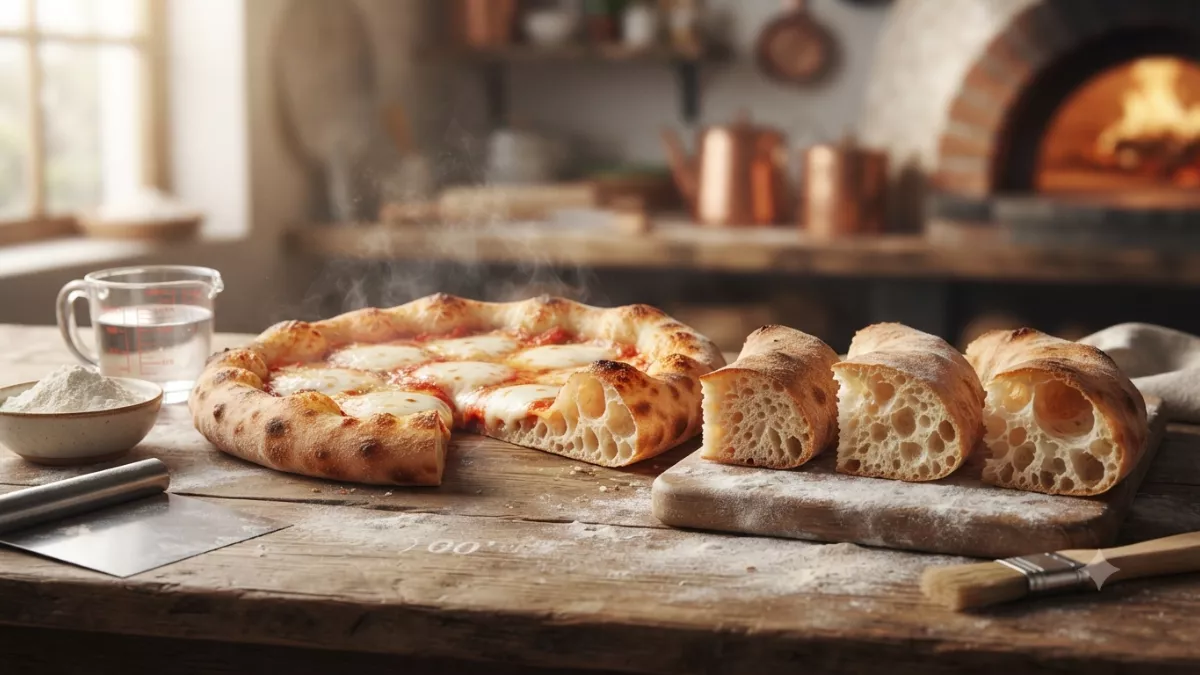
Pizza crust can completely change the way a pizza tastes and feels. One crust may be thin, crisp, and delicate, while another can be soft, airy, chewy, and substantial. Although flour, yeast, fermentation, oven temperature, and shaping all influence the final result, one of the most important factors is hydration.
Hydration refers to the amount of water in a pizza dough compared with the amount of flour. Even a relatively small change in hydration can affect how the dough behaves during mixing, fermentation, shaping, and baking. It can also change the texture of every bite.
Understanding hydration helps explain why some pizzas have a crisp, cracker-like base while others have a soft and open crumb. It also makes it easier to choose or prepare a dough that matches the pizza style you enjoy.
In this guide, we will explain how hydration changes pizza crust texture, what low- and high-hydration doughs are like, how water affects gluten and fermentation, and how home cooks can choose the right hydration for different pizza styles.
What Is Hydration in Pizza Dough?
Hydration is the percentage of water relative to the weight of flour in a dough recipe.
For example, if a recipe contains:
- 1,000 grams of flour
- 600 grams of water
The dough has 60% hydration.
The calculation is:
Water weight ÷ flour weight × 100 = hydration percentage
So:
600 ÷ 1,000 × 100 = 60%
Hydration percentages commonly used for pizza dough can range from the mid-50% range to well above 70%, depending on the flour, pizza style, fermentation method, and baker’s technique.
A 55% hydration dough and a 70% hydration dough can therefore behave very differently even if they use the same flour, yeast, salt, and baking temperature.
Why Does Water Matter So Much?
Water does much more than simply make flour wet.
When water is added to flour, it begins interacting with proteins, starches, enzymes, and other components. The proteins that eventually form gluten need water to hydrate properly.
Water also affects how easily the dough stretches, how fermentation progresses, how much steam is generated during baking, and how the finished crust develops its interior structure.
This means hydration influences several stages of pizza making.
A higher hydration dough generally tends to be:
- Softer
- Stickier
- More extensible
- More open inside
- More difficult to handle
- More capable of producing a light, airy crumb
A lower hydration dough generally tends to be:
- Firmer
- Easier to handle
- Less sticky
- More structured
- More compact inside
- More likely to produce a crisp or dense texture
However, hydration does not work alone. Flour strength, fermentation, temperature, and baking technique all matter.
Low-Hydration Pizza Dough: What Does It Feel Like?
Lower-hydration dough contains less water relative to its flour content.
Because there is less water available, the dough tends to feel firm and manageable. It can often be shaped with less sticking and may require less specialized handling.
When baked correctly, lower-hydration dough can produce a crust with a firm bite and pronounced crispness.
This can work particularly well for pizza styles where structure and crunch are important.
Texture of Low-Hydration Crust
A lower-hydration crust may have:
- A firmer bite
- More pronounced crispness
- A tighter crumb
- Less large air pockets
- Greater structural stability
- A drier overall mouthfeel
That does not mean low-hydration dough automatically produces better pizza. It simply creates a different texture.
For someone who loves a thin, crisp pizza, a lower hydration dough can be an excellent choice.
High-Hydration Pizza Dough: What Changes?
High-hydration dough contains more water relative to flour.
The dough becomes softer and often much stickier. At first, it may feel difficult to handle, especially for someone accustomed to firm dough.
But with the right flour, fermentation, and technique, high hydration can produce an exceptionally light and airy crust.
The additional water helps create conditions for a more open internal structure. During baking, water turns into steam, contributing to expansion and helping create larger pockets of air.
Texture of High-Hydration Crust
A higher-hydration crust may have:
- A lighter interior
- Larger air pockets
- A softer crumb
- A more tender bite
- Greater chewiness
- A crisp exterior combined with a moist interior
This combination of crisp outside and airy inside is one reason high-hydration dough is popular for certain artisan-style pizzas.
How Hydration Changes the Crumb
The crumb is the interior portion of the pizza crust.
If you cut through a pizza, the crumb reveals how much gas was trapped during fermentation and how the dough expanded in the oven.
Hydration can strongly influence this structure.
A lower-hydration dough often produces a relatively tight crumb. The interior may contain smaller and more evenly distributed air pockets.
A higher-hydration dough can support a more open crumb, particularly when it is paired with strong flour and proper fermentation.
You may see:
- Larger air pockets
- Irregular holes
- A lighter interior
- More visible fermentation structure
However, simply adding more water does not guarantee a beautiful open crumb.
If fermentation, gluten development, or shaping is poor, a high-hydration dough can still produce a disappointing result.
Hydration and Gluten Development
Gluten is one of the most important structural components of wheat-based pizza dough.
Two major wheat proteins, glutenin and gliadin, interact with water and mechanical action to form the gluten network.
This network gives dough elasticity and extensibility.
Hydration affects how that network develops and behaves.
With sufficient water, gluten proteins can hydrate more effectively. The resulting dough can become extensible and capable of holding fermentation gases.
However, high hydration can also make dough feel weak or sticky if the flour does not have enough strength to support it.
This is why flour selection becomes increasingly important as hydration increases.
High Hydration Requires Strong Flour
Not every flour handles high hydration equally well.
A stronger flour generally contains enough protein and gluten-forming potential to create a dough structure capable of holding additional water and fermentation gases.
If you take a weak flour and dramatically increase hydration, the dough may become:
- Extremely sticky
- Difficult to shape
- Difficult to launch into an oven
- Prone to spreading
- Weak during fermentation
Strong flour can make higher-hydration dough much easier to manage.
This is one reason professional pizza makers often select flour based on both protein content and intended dough characteristics.
Hydration and Pizza Crust Crispness
Many people assume that higher hydration automatically means softer pizza and lower hydration automatically means crispier pizza.
The reality is more complicated.
Hydration certainly influences crust texture, but baking temperature and time also play major roles.
During baking, water inside the dough turns into steam. The longer the crust remains in the oven, the more moisture can be driven out.
A high-hydration dough baked at a very high temperature for a short time may develop a crisp exterior while retaining a moist, airy interior.
A lower-hydration dough baked longer may lose more moisture and become very crisp throughout.
Therefore, the final texture depends on the relationship between:
Hydration + dough thickness + oven temperature + baking time
Hydration and Chewiness
Chewiness is another characteristic strongly associated with pizza crust.
A moderate-to-high hydration dough can create a pleasant combination of elasticity, extensibility, and chewiness when the gluten network and fermentation are properly developed.
But excessive chewiness is not always desirable.
A pizza can become tough when the dough is:
- Overworked
- Poorly fermented
- Too thick
- Made with unsuitable flour
- Baked incorrectly
The goal is not simply to maximize chewiness.
The goal is to create the right balance between crispness, tenderness, elasticity, and chew.
Hydration and Fermentation
Water also affects fermentation.
Yeast needs water to function effectively, while dough temperature and fermentation time influence how quickly the yeast produces carbon dioxide and other fermentation byproducts.
A properly hydrated dough can support fermentation and allow gases to become trapped inside the gluten network.
During baking, those gas pockets expand rapidly.
This process contributes to oven spring and helps determine the final crumb structure.
Long fermentation can further change the character of the crust by allowing the dough to develop more flavor and a different structural texture.
Does More Water Always Mean Better Pizza?
No.
This is one of the biggest misconceptions about pizza dough.
Higher hydration can create beautiful results, but it also introduces challenges.
A very wet dough may be difficult for beginners to shape. It can stick to the work surface, peel, or hands. It may also spread too much if the gluten network is not strong enough.
Lower hydration can be easier to work with and may be ideal for a pizza style that requires a firmer, crispier base.
The best hydration level is the one that suits the desired pizza style, flour, oven, and skill level.
Common Pizza Dough Hydration Ranges
There is no single universal hydration percentage for every pizza.
As a general guide:
Around 55–60% Hydration
This range produces a relatively firm dough.
It can be useful for:
- Crisp pizza
- Thin crust
- Beginner-friendly dough
- Doughs that need easy handling
The finished crust may have a tighter crumb and firm texture.
Around 60–65% Hydration
This is a versatile range for many home pizza recipes.
The dough can remain manageable while producing a good balance of:
- Crispness
- Chew
- Tenderness
- Airiness
For many home cooks, this range provides a practical starting point.
Around 65–70% Hydration
The dough becomes noticeably softer and stickier.
With suitable flour and technique, it can produce a lighter, more open crumb and a pleasant combination of crisp exterior and soft interior.
Above 70% Hydration
Very high hydration doughs can produce extremely open and airy structures.
However, they require more experience.
Handling, fermentation, shaping, flour strength, and baking technique become increasingly important.
Thin Crust and Hydration
Thin-crust pizza often benefits from dough that can stretch easily without becoming excessively thick.
A moderate hydration level can help create a crust that is easy to stretch while still retaining enough structure for toppings.
For a very thin and crisp style, a lower hydration dough may be appropriate.
But remember that thinness itself has a major impact on texture.
A high-hydration dough can still produce a crispy pizza if it is stretched thin enough and baked under the right conditions.
Thick Crust and Hydration
Thicker pizzas require enough internal structure to support a larger amount of dough.
Moderate or higher hydration can contribute to a softer, more tender interior.
The baking method becomes especially important because thick dough needs enough time for the center to cook without burning the exterior.
A thick, high-hydration crust may be soft and airy inside while developing a nicely browned exterior.
New York-Style Pizza and Hydration
New York-style pizza is often associated with a thin but foldable crust that combines crispness with chew.
Hydration is one part of achieving this texture, but it is not the only factor.
Flour strength, fermentation, dough thickness, oven temperature, and baking surface all influence the final result.
The ideal dough should have enough flexibility to fold without becoming weak or soggy.
Neapolitan-Style Pizza and Hydration
Neapolitan-style pizza is known for a thin center, puffy edge, soft interior, and blistered crust.
Hydration plays an important role in creating this texture.
The dough must be extensible enough to stretch thin while retaining sufficient strength to create a well-developed cornicione, or raised outer edge.
Very high heat then rapidly transforms the dough during baking.
The result can be a crust that is lightly charred outside while remaining soft and airy inside.
How Water Affects Topping Support
Hydration can indirectly affect how well a crust supports toppings.
A crust with a strong structure can better handle heavier toppings.
A very wet, delicate crust may become difficult to manage if overloaded with:
- Fresh vegetables
- Excess sauce
- Large amounts of cheese
- Watery meats
- Moist ingredients
This is why topping quantity must be considered alongside dough hydration.
A beautifully fermented high-hydration crust can still become soggy if it is buried under too many wet ingredients.
How to Prevent a High-Hydration Pizza From Becoming Soggy
If you enjoy soft and airy crust but still want a crisp bottom, pay attention to moisture management.
Try these techniques:
- Preheat the oven thoroughly.
- Use a baking steel or pizza stone when appropriate.
- Avoid excessive sauce.
- Drain very wet ingredients.
- Pat fresh mozzarella dry before using it.
- Avoid overcrowding the pizza.
- Bake on a properly heated surface.
- Use enough heat to create rapid oven spring.
- Allow the bottom to brown sufficiently before removing the pizza.
High hydration does not have to mean soggy pizza.
Good baking technique can create a crisp exterior while keeping the interior pleasantly moist.
How to Measure Hydration Correctly
For accurate results, weigh ingredients rather than relying on cups.
For example, suppose your recipe contains:
- 500 grams flour
- 325 grams water
The hydration is:
325 ÷ 500 × 100 = 65%
If you increase the water to 350 grams while keeping the flour at 500 grams, hydration becomes:
350 ÷ 500 × 100 = 70%
That five-percentage-point change can make a noticeable difference in dough handling and final texture.
This is why professional and serious home pizza makers commonly use a kitchen scale.
Hydration Is Not the Same as Moisture in the Finished Crust
An important distinction is that dough hydration describes the recipe before baking.
The finished crust does not retain all of that water.
During baking, some of the water evaporates as steam.
Therefore, a 70% hydration dough does not mean the finished pizza crust contains 70% water.
The final moisture level depends on:
- Baking temperature
- Baking time
- Dough thickness
- Oven environment
- Ingredient composition
- Topping moisture
Hydration is therefore a starting measurement that influences the entire baking process.
Common Hydration Mistakes
Adding Too Much Water Too Quickly
If you are new to high-hydration dough, adding a large amount of water immediately can make the dough difficult to manage.
Ignoring Flour Strength
A recipe designed around strong flour may behave completely differently when made with a weaker flour.
Using Too Much Extra Flour
Adding large amounts of flour during shaping can reduce the effective hydration and create a heavier crust.
Underbaking
A high-hydration dough may require enough baking time to develop a properly cooked interior.
Overloading the Pizza
Even a well-baked crust can become soggy under excessive wet toppings.
Focusing Only on Hydration
Hydration matters, but fermentation, temperature, gluten development, shaping, and baking are equally important parts of the process.
How to Choose the Right Hydration for Your Pizza
Think about the texture you want before choosing the hydration level.
If you want a very crisp, firm crust, consider a lower hydration dough.
If you want a balanced crust that is crisp outside and tender inside, moderate hydration is a useful starting point.
If you want a light, airy, open crumb, a higher hydration dough may be appropriate.
Your oven also matters.
A home oven operating at a lower temperature may produce different results from a professional pizza oven operating at extremely high temperatures.
The same hydration percentage can therefore behave differently in different environments.
A Simple Home Pizza Hydration Starting Point
For home cooks experimenting with dough, around 60–65% hydration can be a practical starting range.
It provides enough water for a flexible and flavorful dough without creating the handling challenges associated with very high hydration.
For example:
- 500 grams flour
- 300–325 grams water
- 10 grams salt
- Appropriate yeast based on fermentation schedule
From there, you can experiment.
If the crust feels too firm, increase hydration slightly.
If the dough feels too sticky and difficult to manage, reduce hydration or improve gluten development and handling technique.
Change one variable at a time so you can understand what actually affects the result.
How to Experiment With Pizza Hydration
The best way to understand hydration is to conduct your own controlled experiment.
Make three doughs using the same flour, yeast, salt, fermentation schedule, oven, and baking time.
Change only the water percentage.
For example:
Dough A: 58% hydration
Dough B: 63% hydration
Dough C: 68% hydration
After baking, compare:
- Dough handling
- Stretching ability
- Oven spring
- Crust color
- Bottom crispness
- Interior air pockets
- Chewiness
- Moisture
- Overall flavor
This simple experiment can demonstrate just how much hydration changes pizza.
The Perfect Pizza Crust Is About Balance
There is no single hydration percentage that creates the perfect pizza crust.
Pizza texture is the result of multiple variables working together.
Hydration interacts with:
- Flour
- Gluten development
- Yeast
- Salt
- Fermentation
- Dough temperature
- Dough thickness
- Shaping
- Oven temperature
- Baking time
- Baking surface
- Toppings
The best crust balances these elements rather than relying on one ingredient or percentage.
A crisp pizza may require less water and longer baking. A soft, airy pizza may use more water and extremely high heat. A New York-style crust may sit somewhere between those extremes.
The important thing is understanding what hydration is doing so you can adjust it intentionally.
Frequently Asked Questions
What hydration is best for pizza dough?
For many home pizza makers, approximately 60–65% hydration is a practical starting range. The ideal percentage depends on flour strength, pizza style, oven temperature, fermentation, and desired texture.
Does higher hydration make pizza dough crispier?
Not necessarily. Higher hydration can help create a crisp exterior with a soft, airy interior when baked correctly, but baking temperature and time strongly influence crispness.
Is high-hydration pizza dough harder to work with?
Yes. High-hydration dough is generally softer and stickier. Strong flour, proper gluten development, fermentation, and good handling technique can make it much easier to manage.
Does hydration affect pizza flavor?
Hydration primarily affects dough structure and texture, but it can indirectly influence flavor by changing fermentation, browning, and the overall eating experience.
Can I make crispy pizza with high-hydration dough?
Yes. A high-hydration dough can produce a crisp bottom and exterior while remaining soft and airy inside. High oven heat, proper preheating, controlled toppings, and sufficient baking are important.
Final Thoughts
Pizza crust texture explained through hydration becomes much easier to understand once you see water as more than just an ingredient.
Hydration influences gluten development, dough handling, fermentation, oven spring, crumb structure, crispness, chewiness, and moisture. Lower-hydration doughs generally provide more firmness and structure, while higher-hydration doughs can produce softer, lighter, and more open crusts.
But higher does not automatically mean better.
The best hydration depends on the pizza style you want to create, the flour you are using, your fermentation schedule, your oven, and your preferred bite.
If you are experimenting at home, start around the moderate hydration range and make small adjustments. Keep your flour and fermentation process consistent, change one variable at a time, and pay attention to the difference in texture.
Once you understand how water changes pizza dough, you can move beyond simply following recipes and start designing the crust you actually want to eat.