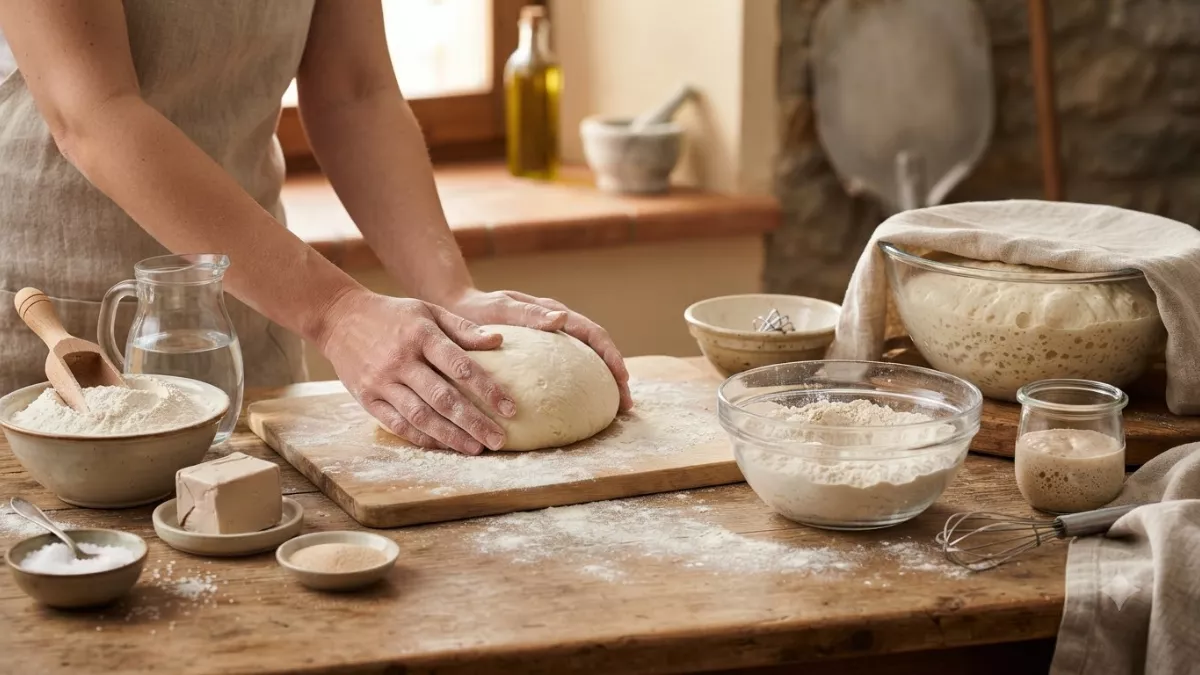
Pizza dough looks simple. At first glance, it seems like nothing more than flour, water, yeast, and salt mixed together and baked in a hot oven. But behind every crisp, chewy, airy, or tender pizza crust is a fascinating combination of ingredients, chemistry, fermentation, and time.
Understanding how pizza dough works can completely change the way you make pizza at home.
Why does one dough produce a crispy crust while another stays soft? Why does overnight dough often have more flavor? What makes a crust chewy? Why does dough sometimes refuse to stretch? And why can changing the amount of water or yeast make such a noticeable difference?
The answer comes down to how the basic ingredients interact.
Flour provides structure. Water activates and hydrates the flour. Yeast drives fermentation. Salt controls flavor and dough development. Time allows all of these processes to work together.
In this complete guide, we’ll explain how each ingredient contributes to pizza dough and why the relationship between flour, water, yeast, and time is so important.
What Is Pizza Dough?
Pizza dough is a fermented mixture of flour, water, yeast, and salt. Depending on the recipe, it may also contain ingredients such as olive oil, sugar, or other additions.
Although the ingredient list is short, pizza dough undergoes several important processes before it reaches the oven.
When flour meets water, proteins begin forming gluten. When yeast is introduced, fermentation begins. As the dough rests, gluten develops and fermentation produces gases and flavor compounds.
Eventually, the dough becomes elastic enough to stretch and strong enough to hold its shape.
Once it enters a hot oven, everything changes again. Water turns into steam, gases expand, the dough sets, and the crust develops its characteristic color, aroma, and texture.
That means a pizza crust is essentially the result of ingredients + technique + fermentation + heat.
1. Flour Provides the Foundation
Flour is the structural foundation of pizza dough.
Most pizza dough is made primarily from wheat flour because wheat contains proteins that can form gluten when hydrated and mixed.
Gluten gives dough its elasticity and strength.
What happens when flour meets water?
Wheat flour contains proteins called glutenin and gliadin. When water is added and the dough is mixed, these proteins interact and form a gluten network.
This network allows pizza dough to:
- Stretch without immediately tearing
- Hold fermentation gases
- Develop elasticity
- Maintain its structure
- Create chewiness in the finished crust
The type of flour you use therefore has a major influence on the final pizza.
Bread flour
Bread flour generally contains relatively high protein levels and can produce strong, elastic dough.
It can be useful for pizza styles where you want a chewy, structured crust.
All-purpose flour
All-purpose flour can also work well for homemade pizza.
It generally produces a dough that is easier to handle and can create a pleasant balance between tenderness and chewiness.
Specialty pizza flour
Some pizza makers prefer finely milled pizza flours designed for specific baking temperatures and styles.
The important point is that there isn’t one universally correct flour.
The best flour depends on the pizza style, hydration, fermentation schedule, oven temperature, and desired texture.
2. Water Hydrates the Flour
Water may appear to be a simple ingredient, but its role in pizza dough is critical.
Without enough water, flour cannot properly hydrate and gluten development becomes limited.
Water also affects dough consistency, fermentation, extensibility, and the final texture of the crust.
What is hydration?
In pizza making, hydration refers to the amount of water compared with the weight of flour.
For example, if a recipe uses 1,000 grams of flour and 650 grams of water, the dough has 65% hydration.
A higher hydration dough contains more water relative to flour.
A lower hydration dough contains less.
Higher hydration
Higher hydration can produce dough that is:
- Softer
- More extensible
- Airier
- More open in texture
- More challenging to handle
Lower hydration
Lower hydration dough tends to be:
- Firmer
- Easier to shape
- More structured
- Less sticky
- Potentially denser
Hydration should therefore be chosen according to the style of pizza you’re making.
3. Yeast Is the Engine of Fermentation
Yeast is responsible for one of the most important processes in pizza dough: fermentation.
Yeast is a living microorganism that consumes available sugars and produces carbon dioxide and other fermentation byproducts.
The carbon dioxide becomes trapped within the gluten network.
That is what helps the dough rise.
Without fermentation, pizza dough would generally be much denser and flatter.
What does yeast contribute?
Yeast helps create:
- Dough expansion
- Air pockets
- Aroma
- Flavor complexity
- Crust structure
- Better texture
However, using more yeast isn’t necessarily the secret to better pizza.
The amount of yeast and the amount of time available for fermentation work together.
A recipe using a small amount of yeast and a long fermentation can produce a very different dough from one using more yeast and a short rise.
4. Time Is One of the Most Important Ingredients
Time isn’t technically an ingredient, but when it comes to pizza dough, it behaves like one.
A dough that ferments for one hour will not develop exactly the same characteristics as dough that ferments for 24 or 48 hours.
During fermentation, several processes are occurring simultaneously.
Yeast produces carbon dioxide and fermentation compounds. Enzymes gradually break down components of the flour. Gluten changes and becomes more relaxed and extensible.
This can result in improved flavor and a more manageable dough.
Short fermentation
A short fermentation might take a few hours.
This approach can be convenient when you want pizza the same day.
The resulting dough can still produce excellent pizza when properly prepared and baked.
Overnight fermentation
An overnight dough gives fermentation more time to develop.
Refrigeration slows yeast activity, allowing the dough to develop gradually.
Many home pizza makers prefer overnight dough because it can offer a more developed flavor and convenient preparation schedule.
Long fermentation
Some doughs are fermented for 24, 48, or even 72 hours under controlled conditions.
Long fermentation requires more careful management because dough can eventually become over-fermented.
More time isn’t automatically better.
The goal is to reach the desired stage of fermentation, not simply to wait as long as possible.
5. Salt Controls More Than Flavor
Salt is essential to pizza dough.
Obviously, it contributes flavor, but its role goes beyond seasoning.
Salt influences yeast activity and helps strengthen the dough’s gluten structure.
Adding salt can slow fermentation, which is useful because uncontrolled yeast activity can cause dough to ferment too quickly.
Salt also improves the overall flavor of the finished crust.
A pizza dough without enough salt can taste surprisingly flat even when the sauce and toppings are flavorful.
When should salt be added?
Different dough-making methods use different approaches.
Some recipes combine salt with the flour and water relatively early. Others incorporate it after initial hydration.
The exact technique matters less than maintaining the correct proportions and ensuring the salt is properly distributed throughout the dough.
6. Gluten Determines Strength and Stretch
Gluten is one of the most important concepts in pizza dough.
When flour is hydrated and mixed, gluten proteins form a network that provides strength and elasticity.
This network must be developed enough to hold fermentation gases but relaxed enough to allow the dough to stretch.
That’s why pizza dough is a balancing act.
Too little gluten development
If the gluten network is underdeveloped, dough may:
- Tear easily
- Spread excessively
- Struggle to hold gas
- Produce a weak crust
Too much resistance
Sometimes dough is strong but difficult to stretch.
This doesn’t necessarily mean the dough needs more kneading.
It may simply need to rest.
Resting allows the gluten network to relax, making the dough easier to stretch without tearing.
This is one reason experienced pizza makers avoid forcing dough into shape.
7. Fermentation Creates the Flavor
Many people think of fermentation mainly as a way to make dough rise.
But fermentation also affects flavor.
During fermentation, yeast and enzymes contribute to the development of aromatic and flavorful compounds.
A properly fermented dough can have more depth than freshly mixed dough.
You may notice subtle notes of:
- Wheat
- Toast
- Fermentation
- Mild sweetness
- Roasted grain
Once the dough enters a hot oven, additional flavors develop through browning.
This means the final flavor of pizza crust comes from both fermentation and baking.
8. Temperature Controls the Speed of the Dough
Temperature has a major effect on fermentation.
Warm environments generally accelerate yeast activity, while cold environments slow it down.
This is why refrigerator fermentation is so useful.
Instead of allowing dough to ferment rapidly at room temperature, refrigeration provides a slower fermentation process.
Warm fermentation
Warm dough can rise relatively quickly.
This is useful for same-day pizza but requires closer attention because the dough can move through fermentation stages quickly.
Cold fermentation
Cold fermentation slows the process.
It can make timing easier and give the dough additional time to develop flavor and structure.
However, cold dough is generally less flexible immediately after refrigeration.
Allowing it to warm gradually before shaping can make handling easier.
9. Dough Temperature Matters
Professional pizza makers often pay close attention to dough temperature.
The temperature of the ingredients, mixing process, fermentation environment, and finished dough can all influence fermentation speed.
For example, using warmer water can accelerate fermentation, while colder water can slow it down.
This means the same recipe can behave differently depending on the temperature of your kitchen.
A dough recipe isn’t really a fixed clock.
It’s better to observe the dough itself.
Look for changes in volume, texture, elasticity, and air development rather than relying exclusively on a specific number of hours.
How to Tell When Pizza Dough Is Ready
One of the most useful pizza-making skills is learning to recognize properly fermented dough.
Depending on the recipe, a ready dough may:
- Increase noticeably in volume
- Feel lighter
- Contain visible air bubbles
- Stretch without immediately tearing
- Feel soft and elastic
- Have a pleasant fermented aroma
The dough should not necessarily double in size in every recipe.
Different fermentation methods and dough formulas produce different visual cues.
The poke test
A gentle poke can sometimes help determine fermentation.
Press your finger lightly into the dough.
If the indentation springs back very quickly, the dough may need additional fermentation.
If the indentation remains completely and the dough feels weak or collapsed, it may be over-fermented.
A gradual response can indicate that the dough is appropriately developed.
The poke test isn’t perfect, but it becomes more useful with experience.
Under-Fermented vs. Over-Fermented Dough
Understanding these two problems can help you troubleshoot pizza dough.
Under-fermented dough
Under-fermented dough may be:
- Dense
- Tight
- Difficult to stretch
- Low in flavor
- Short on visible air pockets
It may also spring back aggressively when you try to shape it.
Over-fermented dough
Over-fermented dough may become:
- Very slack
- Weak
- Difficult to shape
- Excessively sticky
- Less capable of holding structure
It can also have an overly fermented smell.
The ideal point lies between these extremes.
Why Pizza Dough Sometimes Won’t Stretch
If your pizza dough keeps shrinking back after you stretch it, the gluten network may be too tense.
The simplest solution is often to let the dough rest.
Resting gives the gluten time to relax.
Another possibility is that the dough has not fermented sufficiently.
Excessive flour during shaping can also make dough feel stiff and dry.
Instead of continuously stretching and fighting the dough, pause and give it time.
Pizza dough usually responds better to patience than force.
Why Some Pizza Crusts Are Chewy
Chewiness comes from several factors working together.
Flour protein, gluten development, hydration, fermentation, and baking temperature can all influence the final texture.
A stronger gluten network can produce more chew.
Higher-protein flour may contribute to structure.
Adequate fermentation can improve extensibility and texture.
High-temperature baking can create a crisp exterior while leaving enough moisture inside for chewiness.
That’s why a great pizza crust can be simultaneously crisp and chewy.
Why Some Pizza Crusts Are Crispy
Crispness is strongly influenced by moisture and heat.
As pizza dough bakes, water evaporates and the crust dries.
A hot oven encourages rapid surface browning.
A thinly stretched dough generally loses moisture more quickly than a thick dough.
This is why thin pizza can become crisp while thicker pizza remains soft and airy.
Baking surface also matters.
A thoroughly heated pizza stone or steel can transfer substantial heat into the bottom of the dough, helping create a crisp underside.
The Role of Olive Oil and Sugar
Not every pizza dough recipe uses olive oil or sugar.
When included, they can affect the dough and final crust.
Olive oil can contribute richness and tenderness and may influence how the crust browns.
Sugar can provide sweetness and contribute to browning, particularly in lower-temperature home ovens.
However, these ingredients are not required for every pizza style.
Traditional formulas vary considerably, so it’s better to choose ingredients based on the crust you’re trying to create.
A Simple Pizza Dough Formula
For a basic homemade pizza dough, you can start with a simple baker’s-percentage approach.
For example:
- Flour: 100%
- Water: 60–65%
- Salt: around 2%
- Yeast: a small percentage depending on fermentation time
The exact yeast quantity can vary dramatically depending on whether you’re making a same-day dough or a long cold-fermented dough.
Using baker’s percentages makes recipes easier to scale.
If you understand the percentage of each ingredient relative to the flour, you can make smaller or larger batches without changing the fundamental formula.
How Flour, Water, Yeast and Time Work Together
The most important lesson is that these ingredients don’t work independently.
They form a system.
Flour + water = gluten development
Water hydrates flour and allows gluten-forming proteins to interact.
Yeast + available food = fermentation
Yeast produces carbon dioxide and fermentation compounds.
Time = development
Time allows fermentation, enzyme activity, and gluten relaxation to progress.
Heat = transformation
The oven converts the fermented dough into a finished crust through evaporation, expansion, browning, and setting.
Change one part of the system and the rest can behave differently.
For example, increasing water can make the dough softer and potentially more difficult to handle. Increasing yeast can accelerate fermentation. Lowering temperature slows fermentation. Increasing fermentation time changes the dough’s flavor and structure.
Pizza dough is therefore less about following a rigid recipe and more about understanding the relationships between ingredients.
10 Practical Tips for Better Pizza Dough
If you want to improve your homemade pizza crust, keep these principles in mind:
- Measure ingredients accurately. A digital kitchen scale is more reliable than measuring flour by volume.
- Choose flour for your pizza style. Different flours produce different textures.
- Control hydration. Start with moderate hydration before experimenting with wetter doughs.
- Don’t rush fermentation. Give the dough enough time to develop.
- Watch temperature. Kitchen temperature can significantly change fermentation speed.
- Don’t add excessive flour while shaping. Too much flour can make the dough dry and stiff.
- Let tight dough rest. Relaxed gluten is easier to stretch.
- Preheat your oven thoroughly. Pizza benefits from strong heat.
- Use a hot baking surface when possible. A stone or steel can improve bottom browning.
- Learn to read the dough. Volume, bubbles, elasticity, and texture are often more useful than the clock alone.
Frequently Asked Questions
1. What are the four main ingredients in pizza dough?
The four basic ingredients are flour, water, yeast, and salt. Some recipes also include olive oil, sugar, or other ingredients depending on the desired pizza style.
2. Why does pizza dough need time to rise?
Rising gives yeast time to ferment the dough. This produces carbon dioxide, which creates air pockets, while fermentation also contributes to flavor and dough development.
3. Is overnight pizza dough better?
Overnight fermentation can produce more developed flavor and texture, but the ideal fermentation time depends on the recipe, temperature, yeast quantity, and desired crust.
4. What makes pizza dough chewy?
Chewiness is influenced by flour protein, gluten development, hydration, fermentation, and baking conditions. Strong gluten development and suitable flour can contribute to a chewy crust.
5. Why is my pizza dough too sticky?
Sticky dough can result from high hydration, insufficient gluten development, warm temperatures, or simply a dough formula designed to be wetter. Avoid automatically adding large amounts of flour because this can change the intended texture.
Conclusion
Pizza dough may contain only a handful of ingredients, but the science behind it is surprisingly complex.
Flour creates the structural framework. Water hydrates the flour and determines dough consistency. Yeast drives fermentation and creates gases and flavor. Salt controls fermentation and enhances taste. Time allows the entire system to develop.
The final crust is then shaped by heat.
Understanding these relationships makes it easier to troubleshoot dough, adjust recipes, and create better pizza at home. Instead of wondering why one recipe works and another doesn’t, you can start looking at hydration, flour strength, fermentation, temperature, and baking conditions as connected parts of the process.
Once you understand the dough, making great pizza becomes much less mysterious—and a lot more enjoyable.