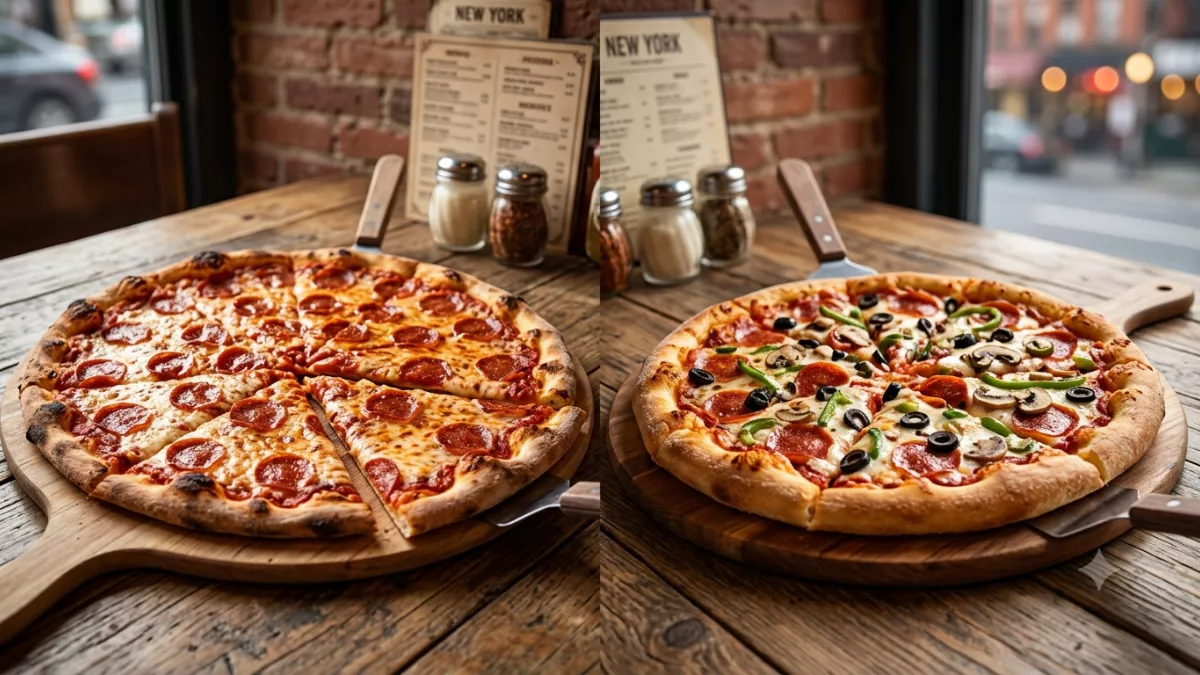
Pizza comes in countless shapes, sizes, textures, and flavors, but few styles are as recognizable as New York-style pizza. Known for its large slices, thin crust, foldable texture, and generous layer of cheese, New York pizza has become one of the most recognizable American pizza styles.
But what exactly makes New York-style pizza different from what people often call “regular pizza”?
The answer is more than simply the size of the slice. The dough, crust thickness, sauce, cheese, toppings, baking process, serving style, and even the way people eat the pizza can be different.
In this guide, we’ll compare New York-style pizza vs. regular pizza and explain what makes each style unique.
What Is New York-Style Pizza?
New York-style pizza is an American pizza style strongly associated with New York City. It is typically characterized by a large, thin, crisp-yet-foldable crust topped with tomato sauce and mozzarella cheese.
A traditional New York slice is usually wide enough to require two hands—or can be folded lengthwise for easier eating.
The crust is one of the most important characteristics. It generally has a crisp exterior while remaining flexible enough to fold without completely breaking.
New York pizza is also commonly sold by the slice, making it convenient for quick meals, casual lunches, and late-night dining.
While recipes vary between pizzerias, the overall style emphasizes a relatively thin crust, balanced sauce and cheese, and a large slice.
What Does “Regular Pizza” Mean?
The phrase regular pizza can mean different things depending on where you live.
Unlike New York-style pizza, “regular pizza” isn’t a single standardized pizza style. Someone might use the term to describe a typical local pizza with a medium-thickness crust, while another person might mean a standard American cheese pizza.
For this comparison, we’ll use “regular pizza” to describe a conventional American pizzeria-style pizza that doesn’t specifically follow the characteristics of New York-style pizza.
That means regular pizza can vary considerably in:
- Crust thickness
- Pizza diameter
- Sauce amount
- Cheese quantity
- Toppings
- Baking temperature
- Slice size
- Texture
This is important because there isn’t one universal recipe for regular pizza.
New York-Style Pizza vs. Regular Pizza: Main Differences
The easiest way to understand the difference is to compare the most important characteristics.
| Feature | New York-Style Pizza | Regular Pizza |
|---|---|---|
| Crust | Thin and foldable | Can be thin, medium, or thick |
| Slice | Large and wide | Usually smaller or varies |
| Texture | Crisp outside, chewy inside | Varies by style |
| Sauce | Relatively light and balanced | Amount varies |
| Cheese | Typically mozzarella | Cheese type and amount vary |
| Toppings | Usually moderate | Can range from light to heavy |
| Serving | Often sold by the slice | Usually served as whole pizzas |
| Eating style | Often folded | Usually eaten flat |
| Shape | Large round pizza | Usually round, but varies |
| Overall style | Thin, crisp, chewy | Highly variable |
Now let’s look at each difference in more detail.
1. Crust Thickness
The crust is probably the most noticeable difference.
New York-style pizza generally has a thin crust compared with many conventional American pizzas.
However, thin doesn’t mean completely crispy like a cracker. A good New York crust has enough structure to support sauce and cheese while remaining flexible.
The center can be relatively thin and tender, while the outer edge provides more chew and structure.
Regular pizza can have almost any crust thickness.
Depending on the restaurant, you may find:
- Thin crust
- Medium crust
- Hand-tossed crust
- Thick crust
- Pan pizza
- Stuffed crust
Therefore, “regular pizza” doesn’t have one specific crust profile.
2. The Famous Foldable Slice
One of the defining characteristics of New York-style pizza is its foldability.
A large New York slice is often flexible enough to fold lengthwise.
This is not merely a novelty. The fold can make a large slice easier to hold and eat, particularly when the center is relatively thin and carries a layer of sauce and melted cheese.
This is one reason the classic New York slice has such a distinctive eating experience.
Regular pizza may also be foldable if it has a thin crust, but folding isn’t necessarily part of the style.
3. Pizza Size
New York-style pizzas are generally known for their large diameter.
A large pizza can produce substantial slices that extend well beyond the size of many conventional pizza slices.
This creates the iconic New York pizza experience: a large triangular slice with a relatively thin center and substantial crust around the edge.
Regular pizza sizes vary much more widely.
A restaurant may offer small, medium, large, and extra-large pizzas, with dimensions depending on the business.
4. Sauce
New York-style pizza generally uses a tomato-based sauce spread across the dough before the cheese is added.
The sauce typically provides acidity, sweetness, herbs, and tomato flavor without completely overwhelming the cheese or crust.
Because the crust is relatively thin, too much sauce can make the center difficult to handle.
Regular pizza can use substantially different sauce amounts and styles.
Some pizzas have:
- Light tomato sauce
- Heavy tomato sauce
- Garlic sauce
- White sauce
- Barbecue sauce
- Pesto
- Cream-based sauces
Therefore, sauce alone doesn’t define regular pizza.
5. Cheese
Mozzarella is central to many New York-style pizzas.
The cheese melts across the sauce, creating the familiar combination of browned cheese, tomato sauce, and crust.
Depending on the pizzeria, different forms and blends of mozzarella may be used.
Regular pizza can use mozzarella as well, but it may also incorporate other cheeses or larger amounts of cheese.
Examples include:
- Cheddar
- Provolone
- Parmesan
- Ricotta
- Monterey Jack
- Cheese blends
Some specialty pizzas use multiple cheeses to create a richer flavor profile.
6. Toppings
New York-style pizza can feature a wide range of toppings, but the classic slice generally isn’t overloaded.
Popular choices include:
- Pepperoni
- Sausage
- Mushrooms
- Onions
- Green peppers
- Black olives
- Meatballs
- Peppers
- Extra cheese
The toppings are usually arranged so the slice remains manageable.
Regular pizza can be much more flexible.
A restaurant may offer everything from simple cheese pizza to heavily loaded combinations containing multiple meats, vegetables, sauces, and cheeses.
7. Baking Temperature and Oven
The baking process has a major impact on the finished pizza.
New York-style pizza is traditionally associated with hot ovens capable of producing a crust that develops both crispness and chew.
The exact oven temperature and baking time can vary between pizzerias and equipment.
Professional pizza ovens can reach temperatures substantially higher than many standard home ovens, allowing pizzas to bake quickly while developing desirable crust characteristics.
Regular pizza may be cooked using different equipment, including:
- Deck ovens
- Conveyor ovens
- Wood-fired ovens
- Gas ovens
- Electric ovens
- Home ovens
The oven, baking surface, dough hydration, and cooking time all influence the final texture.
8. Texture
Texture is another major difference.
A well-made New York-style pizza typically combines several textures in one slice.
The bottom can have a pleasant crispness, while the interior remains chewy and tender. The outer crust generally has more chew and structure.
This combination is part of what makes the style distinctive.
Regular pizza has no single texture profile.
It can be:
- Soft
- Chewy
- Crispy
- Thick
- Fluffy
- Crunchy
- Dense
The texture depends heavily on the specific pizza style.
9. Slice vs. Whole Pizza
New York-style pizza is particularly associated with pizza by the slice.
You can walk into a pizzeria, choose a slice, and have it heated before eating it.
This makes the style particularly convenient for casual meals.
Many regular pizzas are ordered as whole pizzas intended to be shared among several people.
Of course, many non-New York pizzerias also sell slices, so this isn’t an absolute rule.
10. How People Eat It
New York-style pizza is famous for being folded.
The large, flexible slice can be folded lengthwise, creating a more compact shape.
Some people prefer to eat the slice flat, while others fold it almost immediately.
Regular pizza is generally eaten flat with the slice supported from underneath.
The eating style ultimately comes down to personal preference, but the foldable New York slice has become an iconic part of the pizza culture associated with New York City.
Why Is New York Pizza So Thin?
There are several practical reasons for the thin structure of New York-style pizza.
A thinner center allows the large slice to remain manageable. The crust can also develop a combination of crispness and chew without becoming excessively heavy.
The large surface area provides plenty of room for sauce, cheese, and toppings while keeping the overall slice relatively streamlined.
The result is a pizza that feels substantial because of its size while still having a relatively thin center.
Is New York-Style Pizza Crispy or Chewy?
It can be both.
This is one of the most important points to understand about New York-style pizza.
A good slice can have:
- A crisp bottom
- A tender center
- A chewy outer crust
- Melted cheese
- Soft tomato sauce
The contrast between crispness and chewiness is an important part of its appeal.
If you prefer an extremely crunchy crust, you may prefer a different thin-crust style. If you like a combination of crispness and chew, New York-style pizza may be closer to what you’re looking for.
New York-Style Pizza vs. Chicago-Style Pizza
New York-style pizza is often compared with Chicago-style pizza, but the two are dramatically different.
New York pizza generally features a thin, foldable crust.
Chicago deep-dish pizza is much thicker and is built more like a deep pie, with substantial crust and layers of cheese, toppings, and tomato sauce.
The two styles demonstrate how dramatically pizza can vary within American food culture.
Quick comparison
New York-style:
- Thin crust
- Large slices
- Foldable
- Tomato sauce and mozzarella
- Crisp and chewy texture
Chicago deep-dish:
- Deep crust
- Thick structure
- Pie-like construction
- Substantial filling
- Usually eaten with a knife and fork
Neither style needs to be treated as “better.” They simply provide very different pizza experiences.
Can You Make New York-Style Pizza at Home?
Yes.
You don’t need a commercial pizzeria to make a New York-inspired pizza at home, although achieving the exact characteristics of a professional slice can be challenging with a standard home oven.
The key components include:
- Pizza dough
- Tomato sauce
- Mozzarella
- Appropriate toppings
- A very hot oven
- A pizza stone or steel, if available
A pizza stone or baking steel can help transfer heat efficiently to the dough.
For the crust, avoid piling on too many toppings. The goal is to keep the center relatively thin and manageable.
Tips for Making New York-Style Pizza at Home
Stretch the dough carefully
A thin center is important, but you don’t want to completely flatten the dough.
Leave enough structure around the edge to create the characteristic crust.
Don’t use too much sauce
Spread a relatively thin layer of sauce across the dough.
Too much sauce can add unnecessary moisture.
Use moderate toppings
A heavily loaded pizza can become difficult to bake properly in a home oven.
Use enough toppings for flavor without covering the entire surface with thick layers.
Preheat thoroughly
Give your oven plenty of time to reach its maximum appropriate temperature.
If using a pizza stone or steel, allow it to preheat as recommended by the manufacturer.
Watch the crust
The ideal baking time depends on your oven, dough, pizza size, and temperature.
Look for a browned crust, melted cheese, and a cooked center.
Which Pizza Style Should You Choose?
The choice ultimately depends on the type of pizza experience you want.
If you enjoy a large, thin, foldable slice with a crisp and chewy crust, New York-style pizza offers a distinctive experience.
If you prefer more flexibility in crust thickness, toppings, sauce, and preparation, a conventional pizza may provide more variety.
Some people prefer thin crust, while others enjoy thick, soft, crispy, or pan-style pizzas.
The great thing about pizza is that there is no need to limit yourself to one style.
Frequently Asked Questions
Is New York-style pizza the same as regular pizza?
No. New York-style pizza is a specific American pizza style characterized by a large, thin, relatively flexible slice and a crust that balances crispness and chewiness. “Regular pizza” is a broad term that can describe many different preparations.
Why is New York pizza so large?
The large size is part of the style’s traditional presentation. Large pizzas can be cut into substantial triangular slices, which are commonly sold individually.
Why do people fold New York pizza?
The thin, flexible center of a New York-style slice makes it easy to fold. Folding can make a large slice easier to hold and eat.
Is New York pizza always thin?
New York-style pizza is generally thin compared with many other American pizza styles, although thickness and texture can vary between pizzerias.
What cheese is used on New York-style pizza?
Mozzarella is a standard choice for New York-style pizza. Individual pizzerias may use different forms of mozzarella or cheese blends depending on their recipe.
Final Thoughts
The difference between New York-style pizza and regular pizza comes down to more than crust thickness.
New York-style pizza is recognized for its large slices, thin and flexible center, crisp-yet-chewy crust, tomato sauce, melted mozzarella, and convenient slice-based serving style.
“Regular pizza,” meanwhile, is a broad category that can include many different crusts, toppings, sauces, sizes, and cooking methods.
If you’re looking for a pizza that you can fold and eat on the go, the New York style offers a distinctive experience. If you want greater freedom to choose crust thickness, toppings, and preparation methods, the broader world of pizza provides virtually unlimited possibilities.
Ultimately, understanding the differences makes pizza night even more interesting. The next time you order a slice, pay attention to the crust, sauce, cheese, toppings, and texture—you may discover that the style of pizza matters just as much as the ingredients on top.